
The Contract Is Effective. Now Verify the Money: What Texas Agents Should Check About Earnest Money and Option Fee Delivery

A signed contract can feel like a milestone. The offer has been negotiated, the signatures are complete, and the Effective Date is established.
But for the buyer’s agent, the transaction is just getting started.
Paragraph 5 of the One-to-Four Contract addresses delivery of earnest money and the option fee. In the standard form, the buyer must deliver those funds to the named escrow agent within three days after the Effective Date, subject to the contract’s weekend and legal-holiday extension provisions.
That makes the first few days after execution a critical transaction-management window.
For the Buyer’s agent, the practical lesson is simple:
Track the deadline. Verify the delivery. Preserve the record.
Contract Execution Does Not Complete the Payment Process
Once the contract becomes effective, the agent should immediately identify the obligations that have now started running.
For earnest money and an option fee, that means confirming:
- the amount of earnest money;
- the amount of the option fee, if any;
- the escrow agent named in the contract;
- the applicable delivery deadline; and
- whether any additional earnest money is required later.
Paragraph 5A of the contract provides that earnest money and the option fee may be delivered separately or combined in one payment. It also provides an order in which funds received by the escrow agent are applied: first to the option fee, then to earnest money, and then to additional earnest money.
The agent’s job is not merely to know that those provisions exist. The agent should build them into the transaction workflow immediately after the Effective Date is established.
Do Not Rely on Memory or Assumptions
One of the easiest transaction-management mistakes is assuming that someone else handled the money.
The buyer may say, “I sent it.”
The title company may have sent payment instructions.
The contract may have been copied to escrow.
But none of those facts necessarily answers the operational question the agent needs answered:
Was the required money actually delivered within the time required by the contract?
That is why a good system should include a verification step.
The agent should obtain whatever confirmation is reasonably available that the escrow agent received the funds. That typically will be the receipt page of the One-to-Four Family Contract. But depending on the title company and payment method, that may also include an emailed receipt, a transaction-platform confirmation, a wire receipt, a payment confirmation, or another record showing completion.
Receiving and documenting the payment receipt is a critical transaction and compliance step. It helps the agent to avoid running the transaction on an assumption.
The Deadline Matters
The terms of Paragraph 5A of the One-to-Four Family Contract require that earnest money and option fee generally must be delivered within three days after the Effective Date.
If the final day falls on a Saturday, Sunday, or a defined Legal Holiday, the contract extends the delivery period to the end of the next day that is not one of those days.
Agents therefore should calculate the deadline from the actual Effective Date utilizing the method prescribed by the contract rather than relying on a generic reminder such as “three business days.”

Earnest Money and the Option Fee Do Not Have Identical Consequences
Here is where careful reading of the contract becomes especially important.
The current resale contract treats failure to timely deliver earnest money differently from failure to timely deliver the option fee.
Paragraph 5C provides that if the buyer fails to timely deliver the earnest money, the seller may terminate the contract, exercise the seller’s remedies under Paragraph 15, or both, by giving a termination notice before the buyer delivers the earnest money. Once the buyer delivers all the promised earnest money, the seller loses their termination right.
On the other hand, under Paragraph 5D, if no option fee amount is stated, or if the buyer fails to deliver the option fee within the required time, the buyer simply does not have the unrestricted right to terminate under Paragraph 5. The contract is valid and moves forward, but the buyer has no unrestricted termination right.
That distinction is important because agents should not casually describe every missed payment deadline as having the same consequence. It does not.
Verify Actual Delivery Before the Deadline Passes
The strongest transaction systems do not wait until after a deadline to discover whether something happened. A better approach is to create an advance verification point.
For example:
- Immediately after execution: enter the earnest money and option fee deadlines into the transaction system.
- Before the deadline: confirm that the buyer understands the payment instructions and has completed the required step.
- After the buyer reports payment: verify receipt with the escrow agent or through whatever reliable confirmation is available.
- Before the deadline expires: if confirmation is missing, follow up.
That last step is especially important.
An agent who checks after the deadline has already passed may have very different options than an agent who discovers the problem while there is still time to address it.
“Sent” Is Not Always the Same as “Received”
Electronic payments, wires, ACH transfers, checks, and title-company payment portals can all create different practical issues when it comes to the actual receipt of the payment.
A buyer may initiate a payment but encounter:
- incorrect wire instructions;
- a rejected transaction;
- a bank delay;
- an incomplete portal submission;
- insufficient funds;
- a payment that remains pending; or
- simple misunderstanding about where the money was supposed to go.
It’s not the agent’s role to become the bank or escrow officer, but the agent should bear in mind that initiating payment and completing contractual delivery are not always the same operational event. Receipt of the funds is what matters, so the agent should take care to track actual receipt.
Be Careful With Wire-Fraud Risk
Any discussion of earnest money also raises an important security issue concerning wire fraud.
If the buyer chooses to wire funds, agents should avoid casually forwarding or retyping wire instructions. Buyers should be encouraged to independently verify wiring instructions with the title company using a known, trusted phone number before sending funds.
An agent’s transaction-management system therefore should accomplish two things at the same time: verify delivery without weakening wire-fraud safeguards.
The agent wants confirmation that the money was received—not an unnecessary role in transmitting sensitive banking instructions.
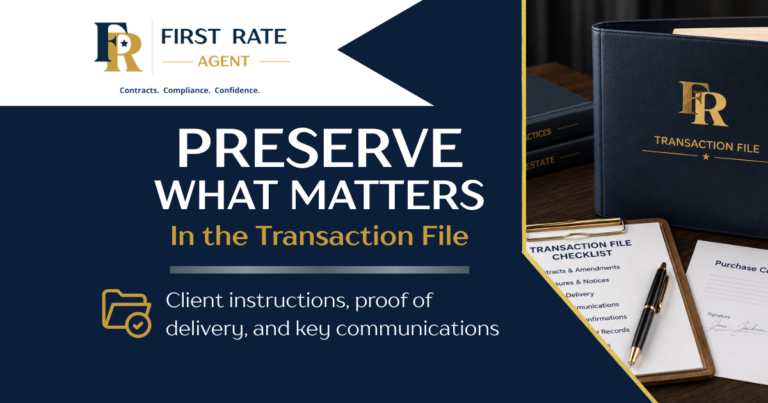
Preserve the Record
Once delivery is confirmed, preserve the available documentation in the transaction file.
That may include:
- the escrow receipt;
- title-company confirmation;
- payment confirmation;
- relevant email correspondence; and
- any substantive communication concerning a delay or problem.
The file should make it possible to determine later:
- What was required?
- When was it due?
- What was delivered?
- When was delivery confirmed?
A clean transaction file should not depend on the agent remembering six months later that “the title company told me they had it.”
What If Something Is Late or Missing?
If the deadline is approaching and the payment has not been confirmed, the agent should act promptly.
That generally means:
- confirm the facts;
- notify the client;
- communicate with the appropriate escrow contact;
- document what happened; and
- involve the broker when the circumstances create a contractual or legal question.
Once a deadline has passed, agents should be particularly careful about telling a client what the contract “automatically” means.
The consequences may depend on which payment was missed, when it was ultimately delivered, whether notice was given, and what the contract permits the parties to do.
That is the point at which careful broker review—or legal advice when appropriate—may be necessary.
The Agent’s Role Is Process Management, Not Guesswork
The best practice is not complicated. It’s a workflow that should begin as soon as the contract becomes effective:
- Track the deadline. Know exactly when the money is due.
- Verify the delivery. Do not assume payment occurred simply because someone intended to make it.
- Preserve the record. Save the documentation that shows what happened.
Those three steps help the agent manage one of the earliest—and most consequential—contractual obligations in the transaction.
A Good File Should Show More Than a Signed Contract
A transaction file can contain a perfectly executed contract and still leave unanswered questions about what happened next.
Earnest money and option fee delivery are good examples.
The contract establishes the obligation. The transaction-management system should show whether that obligation was completed.
A well-functioning transaction management system should show: The contract was signed, the deadline was tracked, delivery was verified, and the record was preserved.
Keep the Transaction Moving After the Contract Is Signed
The first few days after execution can involve several moving parts at once: earnest money, the option fee, inspections, title work, lender activity, and other deadlines.
If you would rather stay focused on advising your client while someone else helps manage the transaction details, Advantage TC can help keep deadlines, documents, communications, and follow-up organized from contract to close.
Schedule a Call With Advantage TC →
This article is provided for educational purposes and is not legal advice. Rights and obligations depend on the applicable contract, statutes, facts, and circumstances. License holders should review the applicable forms, follow brokerage policies, and involve legal counsel when legal interpretation or advice is required.
Related Articles
If you found this article helpful, you may also want to read:
The Seller’s Disclosure Arrives Late. Now What? How Texas Agents Should Manage Delivery, Receipt, and the Buyer’s Next Steps
A practical guide to helping Texas agents document a late Seller’s Disclosure Notice, confirm the buyer’s receipt, identify the applicable timeline, and manage the buyer’s next steps without confusing that process with the Option Period.
The Amendment Is Signed. Now What? How Texas Agents Should Update the Transaction After a Contract Change
A practical guide to helping Texas agents keep deadlines, communications, tasks, and transaction records aligned after the parties sign a contract amendment.
The Inspection Report Is Not a Repair List: How Texas Agents Can Set Better Buyer Expectations
A practical guide to helping Texas buyers understand inspection findings, prioritize repair concerns, manage option-period decisions, and negotiate repairs with clearer expectations.
About Michael Hughes
Michael Hughes is a Texas real estate attorney, broker, educator, and former Managing Broker for eXp Realty Texas, where he oversaw compliance operations for nearly 10,000 agents statewide.
With more than 20 years of legal experience and over a decade in Texas real estate brokerage, Michael helps agents navigate contracts, compliance, risk management, and transaction systems through First Rate Agent and Advantage TC.