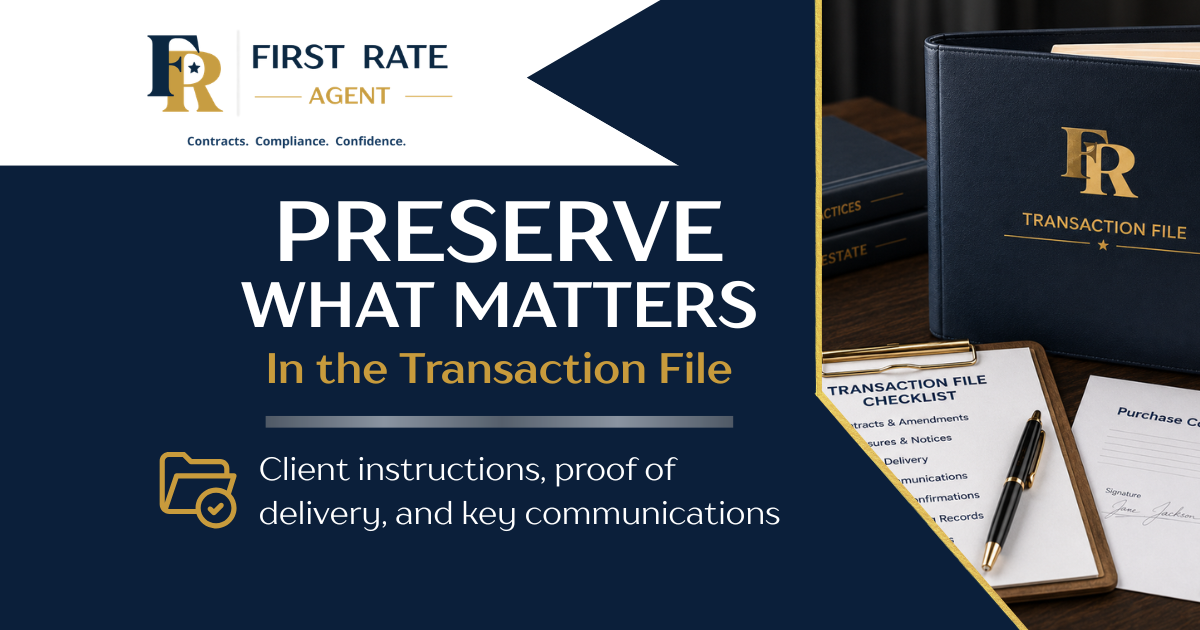
What Texas Agents Should Preserve in the Transaction File
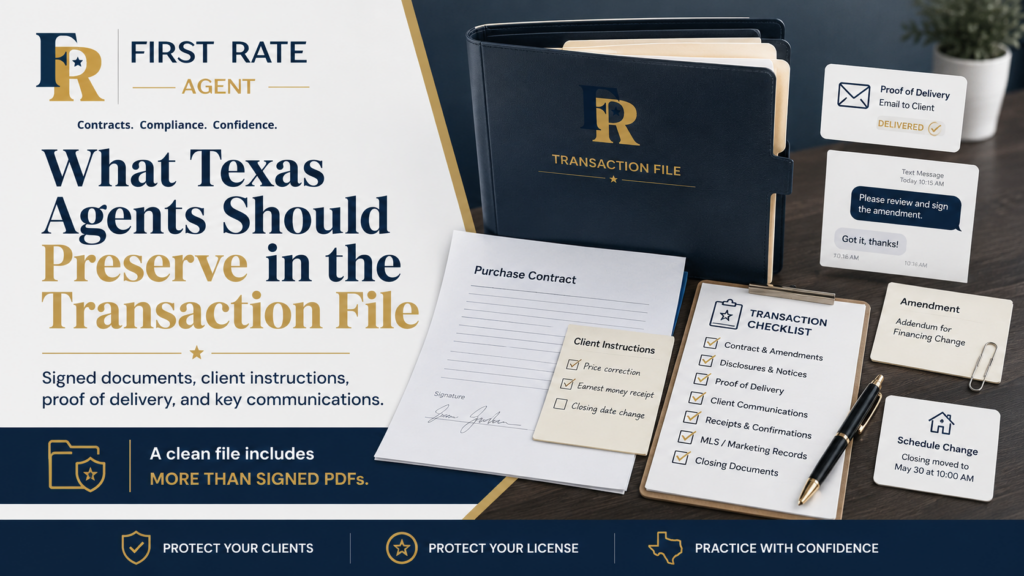
A transaction file should contain more than signed PDFs.
Signed contracts, addenda, disclosures, amendments, and broker-required forms definitely matter. They are the foundation of the file. But they do not always tell the whole story.
A real estate transaction involves much more than the contract documents. Things like client decisions, instructions, negotiations, deadline issues, delivery questions, repair discussions, financing updates, title concerns, inspection items, and closing details.
Some of those things do appear in the signed documents, but many do not. That is why a clean transaction file should preserve more than the final paperwork. It should also preserve the important parts of the transaction that may need to be reviewed, explained, or defended later.
The important question is this:
Could someone review the file later and understand the important parts of what happened? Does the transaction file tell the whole story of what happened?
If the answer is no, then it’s time to have a look at what we’re actually preserving in the transaction file.
The Transaction File Should Tell the Story of the Deal
A clean file should enable someone not connected with the transaction to understand how the transaction moved from contract to closing. The things that must be included and preserved in the file are the materials that help tell that story.
A reviewer should be able to see:
- what was signed
- what was delivered
- what deadlines applied
- what changed
- what the client instructed
- what major issues arose
- how those issues were handled
- whether required documents were preserved
- whether the file supports the transaction history
That is the real purpose of a transaction file. It’s more than a collection of PDF files. It should be a record of the deal.
Start with the Signed Documents
The signed documents are the first place to start. At a minimum, the transaction file should include the final signed versions of all documents that apply to the transaction.
Depending on the file, that may include:
- the executed contract
- applicable addenda
- amendments
- seller’s disclosure notice
- lead-based paint documents, if applicable
- HOA or property owners’ association documents
- temporary lease forms
- non-realty items addendum
- backup contract documents
- termination documents
- buyer or seller representation documents
- compensation-related documents required by your broker
- broker-required internal documents
- transaction-specific notices, disclosures, or acknowledgments
The exact file will depend on the transaction.
A clean file should make it easy to find the final signed version of each important document. If a reviewer has to search through email attachments, downloads, e-sign folders, and duplicate drafts to figure out what was actually signed, the file is not as clean as it should be.
Preserve Client Instructions
Client instructions are one of the most important things to preserve. They are also one of the easiest things to lose or to overlook.
Real estate agents often receive instructions in ways that are not traditional, written instructions. It might be by a verbal conversation, by text, by email, through a portal, in an app message, or during a rushed phone call. That may be convenient or necessary in the moment, but it can create problems later if the instruction is not preserved in a file-friendly way.
For example, the file should preserve important client instructions about:
- offer terms
- counteroffer decisions
- repair requests
- repair negotiations
- seller concessions
- financing terms
- appraisal decisions
- waiver of objections
- extension requests
- termination decisions
- possession timing
- temporary lease issues
- closing delays
- acceptance of risk
- decisions to proceed despite a known issue
A good rule of thumb is this: If the instruction affects the contract, the client’s position, the deadline, the negotiation, the transaction strategy, or the decision to proceed, it probably should be preserved. In other words, if it matters, it needs to be captured in the file.
That does not mean every instruction requires a long memo. Often, a simple written confirmation email is enough.
For example:
“Confirming that you would like us to submit the offer with the terms we discussed.”
“Confirming that you have decided not to request additional repairs.”
“Confirming that you would like to accept the counteroffer.”
“Confirming that you understand the deadline and want to proceed.”
Those confirmations can be simple. But they help preserve the record.
The file should not depend entirely on the agent’s memory. Memory fades. Written records are required.
Save Proof of Delivery
Many transaction problems are not just about whether a document existed. They are about whether it was delivered and when it was delivered.
That is why it’s important to obtain and to save proof of delivery for important items. A clean transaction file should make it easy to determine what was delivered, when it was delivered, and to whom it was delivered.
Depending on the transaction, that may include proof of delivery for:
- executed contract documents
- amendments
- notices
- seller’s disclosure notice
- lead-based paint documents, if applicable
- HOA documents
- title commitment and exception documents
- survey documents
- option fee confirmations
- earnest money confirmations
- repair documents
- termination documents
- lender requests
- title company requests
- client instructions
- important transaction communications
The file should not rely on “I know I sent it.” It should show the actual time and means of delivery.
That may mean saving email records, platform delivery confirmations, e-signature completion certificates, title company confirmations, document portal records, signed acknowledgments, or other written evidence that supports the transaction timeline.
Delivery records are especially important when deadlines are involved. If a document was required to be delivered by a certain time, the file should help show whether that happened as required.
Document Substantive Communications
A real estate transaction involves many communications that may matter later. Some are routine, and some are substantive. The substantive communications are the ones agents should be especially careful to preserve. TREC rules require it, and doing so can prevent small issues from becoming large problems later.
Substantive communications may include communications about:
- contract terms
- negotiation positions
- client instructions
- repair issues
- inspection concerns
- financing issues
- appraisal issues
- title issues
- survey issues
- HOA issues
- closing delays
- possession issues
- termination decisions
- amendments
- objections
- risk disclosures
- important third-party updates
These communications may happen with clients, other agents, brokers, title companies, lenders, inspectors, contractors, appraisers, attorneys, and other people involved in the deal. If the communication affects the transaction, the file should probably preserve it in some reasonable way. If the communication matters to the transaction, preserve it in the file.
The file should show more than the final result. It should help explain how the transaction got there.
Be Careful with Text Messages and Messaging Apps
Text messages are convenient, quick, and easy. They are also dangerous if agents treat them as a complete transaction record.
Texts can be hard to search, hard to organize, hard to export, and hard to preserve. Messaging apps can create even more problems, especially when conversations are spread across Messenger, WhatsApp, Telegram, Signal, Instagram messages, and other platforms. In addition to there being several potential places where communications may reside, none of those messaging platforms lend themselves to easy preservation of the conversations.
That does not mean agents shouldn’t communicate by text. Texting is an important part of today’s real estate practice. But it does mean agents should be careful about letting important transaction instructions live only in text messages.
If a client gives an important instruction by text, the agent should consider confirming it in a more file-friendly format, such as email.
For example:
“Confirming your text message that you would like us to proceed with the repair amendment as drafted.”
or:
“Confirming that you have decided to move forward without requesting additional repairs.”
Granted, that does require an extra step in an already-crowded work process – to send the follow-up email. But for the important communications, it’s an extra step very well taken to preserve the discussion and to have a clean file.
The goal is to make sure important transaction decisions do not disappear into a phone or get erased completely.
Use File-Friendly Confirmation Habits
One of the simplest ways to preserve important communications is to build file-friendly confirmation habits. That means confirming important conversations in writing by email.
For example:
- after a phone call about offer terms
- after a repair negotiation
- after a client decides not to pursue an issue
- after a deadline discussion
- after a title concern comes up
- after a financing or appraisal issue develops
- after a client gives an instruction by text
- after an amendment changes the transaction timeline
These confirmation emails do not need to be complicated. They just need to be clear.
A good confirmation usually identifies:
- what was discussed
- what the client decided
- what action will be taken
- what deadline or next step matters
- whether any follow-up is needed
For example:
“Thank you for speaking with me today about the inspection report. Confirming that you would like us to request the repairs listed in the attached amendment and send it to the seller’s agent today.”
That simple message can do several things at once. It confirms the conversation. It documents the instruction. It identifies the action to be taken. It helps preserve the file. It also can quickly identify any miscommunications or misunderstandings that may have happened during the earlier conversation.
It’s a simple habit that can pay big dividends.
Preserve the Evolution of the Transaction
Most transactions change after the contract is signed. In fact, it’s rare for a real estate deal to close with no changes or amendments to the original agreement. A clean file should preserve the evolution of the transaction and capture the changes.
For example, the file should help answer questions like:
- What did the original contract say?
- What addenda were included?
- What deadlines applied?
- What notices were delivered?
- What issues came up?
- What did the client instruct?
- What changed by amendment?
- What documents were later delivered?
- What was resolved before closing?
- What remained unresolved, if anything?
- How did the transaction reach closing?
That is why file organization matters. If the file contains documents but does not preserve the timeline, the file may still be hard to review.
There are a few things an agent can do to help with this. Use clear file names. Save final signed versions. Keep amendments in order. Preserve delivery records. Keep client instructions and important communications where they can be found.
Ultimately, the file should not require detective work to understand what happened.
The Review Test
Here is a practical test to see if the file is a clean one, or if it needs some work: Could someone review the file six months from now and understand the key agreement, key events, and important communications without searching your phone?
If the answer is yes, the file is probably in good shape. If the answer is no, the file may need work.
A transaction file should not depend on scattered texts, vague memories, missing attachments, or old email searches. It should preserve the important materials in a way that makes the transaction understandable later.
To accomplish this, agents should build a habit of asking: “Would this matter if someone reviewed the file later?” If the answer is yes, preserve it.
What Probably Does Not Need to be Saved
Not every message needs to be preserved in the transaction file. Only those communications that are “substantive,” or important to the deal, need to be captured and saved.
Routine scheduling messages, casual updates, simple appointment logistics, and minor communications may not need to be placed in the formal file unless they affect the transaction in some meaningful way.
For example, these may not need to be separately preserved:
- “Inspector is running five minutes late.”
- “I will call you after the showing.”
- “The title company has parking behind the building.”
- “I will send that over shortly.”
- “The photographer confirmed the appointment.”
But context matters so it’s difficult to give any black-and-white rules for this. If a seemingly routine message relates to a deadline, delivery, instruction, dispute, cancellation, access issue, inspection issue, repair issue, or client decision, it may become important.
The main issue is whether the message conveyed information that was important to the transaction, regardless of how the message was delivered and whether it seemed formal or casual at the time.
The Real Takeaway
A transaction file is more than a storage folder. It is the record of the deal and it is a resource for the agent.
Signed documents matter. But so do client instructions, proof of delivery, substantive communications, amendments, deadline records, and the materials that explain how the transaction moved from contract to closing.
Texas agents who preserve the right materials make their files easier to review, easier to explain, and easier to defend later. That is more than just a compliance habit. It’s professionalism.
You don’t have to save everything, but you do need to preserve what matters.
Related Articles
If you found this article helpful, you may also want to read:
How Texas Agents Can Build an Audit-Ready Transaction File From Day One
A practical guide to building cleaner, more reviewable transaction files from day one by organizing signed documents, deadlines, proof of delivery, amendments, and key communications before the file gets messy.
How Texas Agents Should Clean Up Their Offer Templates After a TREC Form Change
A practical guide to finding and removing outdated contract forms, saved offer packets, e-sign templates, addenda bundles, and workflow shortcuts after a TREC form change.
July 1 TREC Contract Changes: 5 Things Texas Agents Should Check Before Writing Their Next Offer
A detailed look at how extensive TREC form changes create file-quality issues along with changes to the forms themselves.
About Michael Hughes
Michael Hughes is a Texas real estate attorney, broker, educator, and former Managing Broker for eXp Realty Texas, where he oversaw compliance operations for nearly 10,000 agents statewide.
With more than 20 years of legal experience and over a decade in Texas real estate brokerage, Michael helps agents navigate contracts, compliance, risk management, and transaction systems through First Rate Agent and Advantage TC.
Need Help Preserving What Matters in Your Transaction Files?
Clean transaction files do not happen by accident. They come from organized documents, reliable deadline tracking, proof of delivery, preserved communications, and a system that makes important transaction details easier to find later.
If your transaction records are scattered across email, e-sign platforms, cloud folders, text messages, app messages, and downloads, Advantage TC can help you put a cleaner contract-to-close process in place.
A well-managed file does more than store signed PDFs. It helps preserve the client instructions, delivery records, amendments, deadline items, and key communications that may need to be reviewed, explained, or defended later.