July 1 TREC Contract Changes: 5 Things Texas Agents Should Check Before Writing Their Next Offer
Texas agents are used to form updates. But the July 1, 2026 TREC contract changes are not something to casually ignore or “figure out later.”
When a revised contract form becomes mandatory, the risk is not just that an agent might use the wrong form. The bigger risk is that the agent continues using old habits, old templates, old saved packets, old checklists, and old assumptions after the forms have changed.
That is where avoidable mistakes happen.
The revised TREC contract forms touch several practical areas agents deal with in real transactions, including notices, addenda, legal holidays, compensation language, disclosures, and the way contract documents are organized. Even if you are not trying to memorize every form change, you do need a clean process for making sure your next file is started correctly.
Here are five things Texas agents should check before writing their next offer.
1. Make sure you are using the current form — not an old saved version
This sounds obvious, but it is one of the easiest mistakes to make.
Most agents do not start from a blank form every time. They use saved transaction packets, old templates, brokerage form libraries, DocuSign rooms, ZipForm templates, transaction management systems, or prior deals as a starting point.
That can be efficient — until the forms change.
Before writing your next offer, check the actual form version. Do not assume your platform has already updated everything. Do not assume your saved templates are current. Do not assume a form packet you built earlier this year is still safe to use.
This is especially important if you have:
- saved buyer offer packets
- listing-side contract review templates
- team transaction templates
- brokerage compliance checklists
- repeat transaction folders
- old PDF versions saved on your computer
- prebuilt DocuSign or transaction management templates
A form update is not just a “forms provider” issue. It is a workflow issue.
2. Recheck your addenda habits
One of the most practical changes agents need to notice is the reorganization of addenda and notices in Paragraph 22.
For years, many agents have developed muscle memory around where addenda are referenced, how they are grouped, and how they are reviewed before sending a contract for signature. When a contract reorganizes those items, the risk is that an agent thinks the file is complete because “that’s how I’ve always done it.”
That won’t be good enough.
Before you send an offer, slow down and confirm which addenda and notices are actually needed for that transaction. Go through paragraph 22 carefully and use it as a checklist.
Common examples include:
- Third Party Financing Addendum
- Addendum Concerning Right to Terminate Due to Lender’s Appraisal
- Addendum for Property Subject to Mandatory Membership in a Property Owners Association
- Lead-Based Paint Addendum
- Seller’s Disclosure Notice
- Non-Realty Items Addendum
- Temporary lease forms
- Back-up contract documents
- special statutory notices or property-specific disclosures
The point is not just to attach a bunch of forms. The point is to make sure the right forms are attached, the correct boxes are checked, and the final signed contract package matches the deal the parties intended to make.
3. Pay close attention to notices and delivery
Notice delivery is one of those topics that seems simple until something goes wrong.
The revised contract language clarifies acceptable delivery methods and when notices are effective. That matters because notice timing can affect option periods, financing deadlines, termination rights, back-up contract movement, amendment negotiations, and other key transaction events.
Agents should be careful about relying on casual communication habits.
A text message may be convenient. A phone call may move the conversation forward. But the question in a contract file is not merely, “Did everyone know what was happening?”
The better question is: Did the notice get delivered in a way that satisfies the contract?
This is where agents can get themselves into trouble. If a buyer needs to terminate, object, amend, deliver something, or respond by a deadline, the file should clearly show what was sent, when it was sent, how it was sent, and to whom it was sent.
A clean transaction file should make the notice history easy to reconstruct.
4. Update your deadline system before the transaction starts
Contract changes can create deadline confusion when agents keep using an old checklist.
If your checklist, spreadsheet, CRM task list, or transaction tracker was built around the prior form language, do not assume it still works perfectly.
Before your next contract, review your deadline system for items such as:
- effective date
- option period
- earnest money deadline
- option fee deadline
- seller’s disclosure timing
- HOA or resale certificate timing
- financing-related deadlines
- appraisal-related deadlines
- objections and notices
- temporary lease dates
- closing and funding expectations
- possession timing
- amendment follow-up items
Even when the basic deadline did not change, the form around it may have changed enough to justify a fresh review.
This is also a good time to stop relying on memory.
Good agents miss deadlines not because they do not care, but because they are juggling too many moving parts at once. You know the drill – a buyer calls and diverts your mind from what you were doing. A lender needs something. The title company asks for clarification. The other agent sends an amendment. And somewhere in the chaos, a deadline gets overlooked.
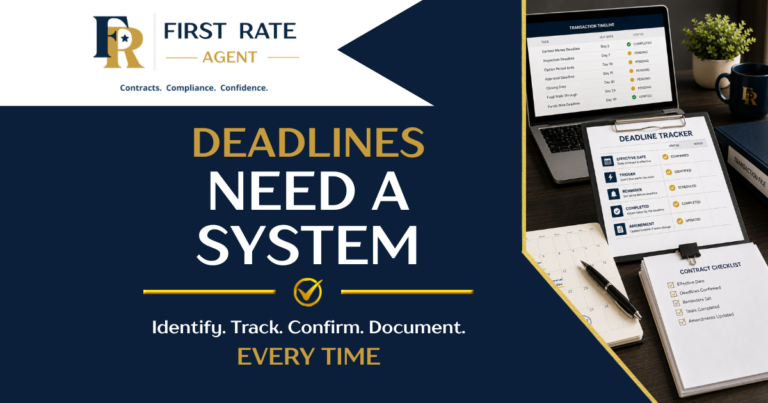
A written deadline tracker is not busywork. It is a protection system.
Free Resource: Texas Transaction Deadline Tracker
If you are updating your process for the July 1 TREC form changes, this is a good time to stop relying on memory for key dates.
Download the free tracker and use it at the start of your next file to organize important dates, delivery items, and follow-up tasks before the transaction gets chaotic.
5. Review compensation language carefully
The revised forms also reflect the industry’s continued shift around compensation language.
This is an area where agents should avoid casual explanations, old scripts, and assumptions based on how things used to work. Paragraph 12 and related compensation provisions deserve careful attention.
That does not mean every agent needs to turn a blog post into a legal seminar. But it does mean agents should be careful before saying things like:
- “This is how we always do it.”
- “The seller always pays that.”
- “The buyer does not need to worry about that.”
- “This is just standard.”
- “We can clean it up later.”
Compensation terms should be clearly discussed, properly documented, and consistent with the brokerage’s policies and the client’s instructions.
If you are unsure how your broker wants these issues handled, ask before you write the offer — not after the contract is signed.
The real issue: your transaction process needs to change when the forms change
The July 1 TREC form changes are not just about knowing which paragraph was revised.
They are a reminder that every agent needs a reliable transaction process.
That process should answer basic questions like:
- Are we using the current form?
- Are all required addenda attached?
- Have the correct notices been delivered?
- Are all deadlines tracked in writing?
- Does the file show what happened and when?
- Would this file make sense if a broker, auditor, or attorney reviewed it six months from now?
That last question matters.
A transaction file should not require detective work. If someone has to piece together what happened from scattered texts, emails, PDFs, and memory, the file is weaker than it should be.
What agents should do this week
Before your next offer, take 20 minutes to review and clean up your process.
Start with these steps:
- Delete or archive old saved form packets that could cause confusion.
- Confirm your form platform is showing the current TREC versions.
- Update any team or personal transaction checklist.
- Review your Paragraph 22 addenda workflow.
- Make sure your deadline tracker reflects how you actually manage files.
- Ask your broker how the brokerage wants compensation language handled.
- Stop relying on memory for deadline and notice tracking.
The agents who handle this well will not necessarily be the agents who can recite every form change from memory.
They will be the agents who update their systems before the next problem appears.
Need a cleaner way to track your next Texas transaction?
A missed deadline or incomplete file can create stress fast.
To help, I created a free Texas Transaction Deadline Tracker you can use to organize the key dates, delivery items, and follow-up points in your next transaction.
Download the free tracker, use it at the beginning of the file, and make your next transaction easier to manage from day one.
Because the goal is not just to get the contract signed.
The goal is to keep the file clean all the way to closing.
Related Articles
If you found this article helpful, you may also want to read:
The Hidden Liability of Text Messages in Real Estate Transactions
A clear-eyed look at the potential dangers of text messaging in real estate transactions and thoughts on how to capture and preserve substantive communications.
The Most Expensive Mistake Agents Make Before They Ever Reach the Closing Table
A practical look at why contract review and file organization need to start before the transaction is already in trouble.
The Most Common Texas Real Estate Contract Mistakes Agents Make
A breakdown of common contract mistakes that can create confusion, delays, and compliance issues.
About Michael Hughes
Michael Hughes is a Texas real estate attorney, broker, educator, and former Managing Broker for eXp Realty Texas, where he oversaw compliance operations for nearly 10,000 agents statewide.
With more than 20 years of legal experience and over a decade in Texas real estate brokerage, Michael helps agents navigate contracts, compliance, risk management, and transaction systems through First Rate Agent and Advantage TC.
Need Help Keeping Transaction Files Clean?
Advantage TC helps Texas agents keep contract-to-close files organized, deadline-aware, and easier to review. If your transaction files are scattered across emails, texts, screenshots, and last-minute uploads, it may be time to put a cleaner system in place.
A well-managed file does not just make closing easier. It makes the transaction easier to explain later.