The Hidden Liability of Text Messages in Real Estate Transactions

Text messages are quick, simple, and they feel casual. That is exactly what makes them dangerous.
In a real estate transaction, a quick text can confirm a repair request, clarify a deadline, discuss lender status, explain a buyer’s concern, communicate seller instructions, or change the tone of an entire negotiation.
The problem is that many agents treat text messages like a conversation, while regulators, brokers, attorneys, clients, and opposing parties may later treat them like something else – evidence.
And if those texts are not saved, organized, or included in the transaction file, they can create a serious problem after the deal is over.
The Real Issue Is Not Texting. It Is Unmanaged Texting.
Texting is not the enemy. In fact, text messages are often the fastest and most practical way to communicate during a transaction. Clients expect quick responses. Other agents expect quick updates. Inspectors, lenders, title companies, and transaction coordinators often use texting because it keeps things moving.
A text may show what was requested, what was disclosed, what was approved, what was rejected, what was misunderstood, or what someone later claims they relied on. That makes texting convenient during the transaction, but potentially painful after the transaction.
The issue is not whether agents should ever text. The issue is whether agents understand that a text message can become a substantive communication that is part of the transaction history.
Why Text Messages Create So Much Risk
Most agents are careful with contracts, amendments, notices, addenda, and emails. They consider their words, proofread, and treat them with respect because they are written communications concerning the transaction.
But text messages are different.
They often happen quickly, informally, and under pressure. They may be written while an agent is walking into a showing, sitting in a car, waiting on a client, or trying to keep a deal from falling apart. The agent may be frustrated, angry, flustered, in a hurry, or any other emotion we can imagine.
That is when mistakes happen.
An agent may text something that sounds like legal advice.
An agent may summarize a contract term too casually.
An agent may say a seller “agreed” to something before it is in writing.
An agent may tell a buyer a deadline is “probably fine” without confirming the contract language.
An agent may receive important client instructions but never move them into the file.
The text may seem harmless in the moment. But months later, if there is a dispute, that same text may become the message everyone focuses on.
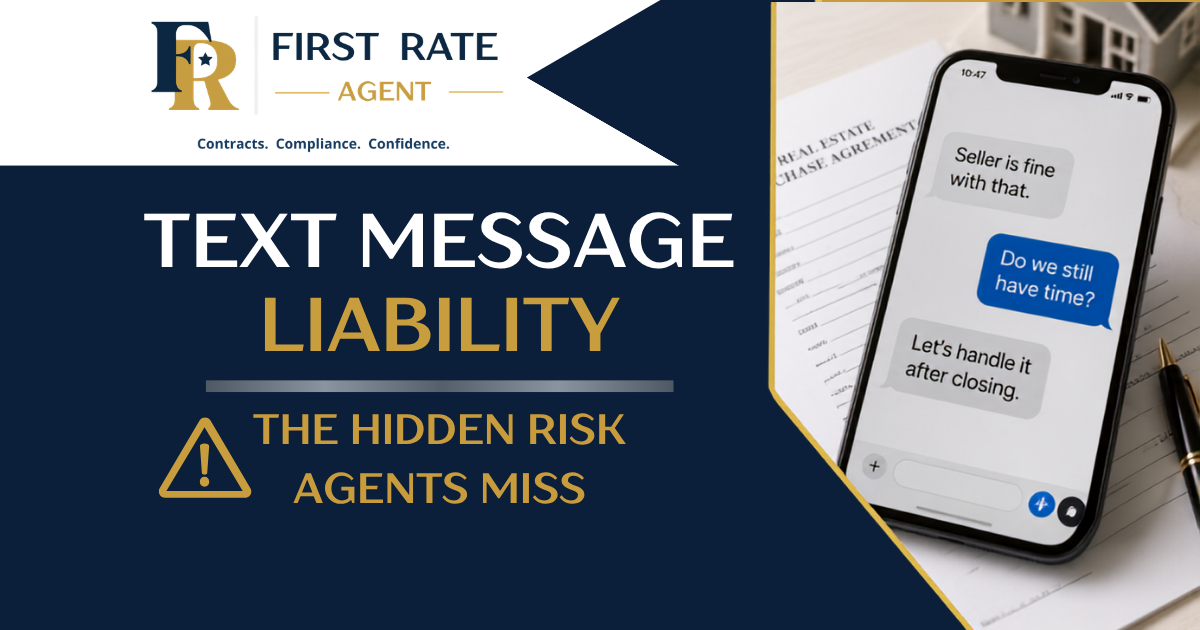
The Most Dangerous Texts Usually Are the Casual Ones
The highest-risk texts are not always the ones that look dramatic, when everything is on the line. Often, they are the short, casual messages that appear harmless at the time:
“Seller is fine with that.”
“Don’t worry, we still have time.”
“That repair should be covered.”
“I think the option period runs through Friday.”
“Buyer said they’re okay moving forward.”
“Just tell them we’ll take care of it after closing.”
Each of those statements may create a problem if it is incomplete, inaccurate, misunderstood, or not supported by a signed document.
Real estate transactions depend on written agreements, deadlines, notices, and documented instructions. A loose text message can blur those lines.
Text Messages Can Become Substantive Transaction Communications
One of the biggest mistakes agents make is assuming that only contracts and emails belong in the transaction file. That simply is not true. In today’s world, text messages are written communications just as much as certified mail. And they must be treated with the same respect.
If a text message contains substantive communication about the transaction, TREC rules say that it needs to be preserved as part of the transaction file. That could include messages about negotiations, client instructions, repair discussions, inspection issues, financing problems, title issues, closing extensions, contract deadlines, possession, leasebacks, or material property concerns, among others.
In other words, the issue is not the communication method. The issue is the content.
If the message affects the transaction, explains a decision, confirms an instruction, or relates to a material issue, it should not live only on someone’s phone. It must be captured and preserved as part of the transaction file.
The Cell Phone Is Not a Transaction File
This is where many agents and brokerages get exposed.
The agent may have important text messages on their phone, but those messages are not saved in the brokerage file. They may be buried in a long thread. They may be mixed with personal messages. They may be deleted when a phone is replaced, stolen, broken, or reset. They may be inaccessible if the agent changes devices, changes brokerages, or leaves the business.
That creates a practical problem. If the broker later needs to respond to a complaint, audit, lawsuit, demand letter, or client dispute, the transaction file may not tell the full story. Even worse, the missing texts may be the very communications needed to explain what happened and make it all go away.
A good transaction file should not depend on whether someone can still scroll back through an old phone.
Texting Can Also Create Client Expectation Problems
There is another hidden issue with texting: speed.
Once an agent starts communicating heavily by text, clients often expect immediate responses. That can create pressure to answer quickly, even when the issue deserves a more careful, measured response.
This is especially risky when the client asks questions like:
“What should we do about the inspection?”
“Can we still terminate?”
“Do we have to disclose this?”
“Can we keep the earnest money?”
“Should we accept this amendment?”
“Can we make them fix it?”
Those questions may involve legal rights, contract interpretation, negotiation strategy, broker policy, or a need for written documentation. It’s the type of thing where accuracy is much more important than an immediate response.
Shooting back a quick response message may feel helpful at the time. But the better decision is often to slow the conversation down. Acknowledge the client’s message and tell them you will verify the information and answer the question later. Confirm the issue and then move the conversation into a more appropriate format, such as email or promulgated forms.
A Better Rule – Text for Logistics, Document the Substance
A practical rule for agents is this: Use text messages for logistics. But be careful using them for substance.
Texting is generally fine for simple logistical updates:
“I’m running five minutes late.”
“The inspector is at the property.”
“Title confirmed receipt.”
“The seller signed. I’ll send the document shortly.”
“The showing is confirmed for 2:00.”
But when the conversation moves into rights, obligations, deadlines, repairs, objections, termination, financing, disclosures, possession, or instructions, the agent should be much more careful.
That does not mean the agent can never text about those issues. It just means the agent should document the conversation properly.
For example:
“Thanks. I’ll confirm this by email so we have it documented.”
“Please send that instruction by email.”
“I’ll prepare the proper form and send it for signature.”
“Let’s make sure this is handled in writing.”
“I can’t give legal advice on that, but I can help you get the issue to the right person.”
That kind of response protects the client, the agent, and the broker.
The Problem With Screenshots
When it comes to capturing and preserving text messages, a lot of agents rely on screenshots to save text messages. And while screenshots are better than nothing, they are far from a perfect system.
Screenshots can be incomplete. They may not show the full conversation. They may not clearly identify the participants. They may omit dates or times. They may be hard to search later. They may be saved to the wrong place or never uploaded to the file.
If screenshots are used, they should be clear, complete, and saved in the correct transaction file with a meaningful file name that can be searched easily should the need arise later on.
For example:
“Buyer Repair Instruction Texts – 06-18-2026”
“Seller Approval of Extension Discussion – 06-20-2026”
“Inspection Access Text Thread – 06-21-2026”
A vague image file sitting in a camera roll is not an organized compliance record.
For best results, there are apps available that will convert entire text conversations to PDF files that can be saved and uploaded to the broker’s file retention system.
Brokerages Should Have a Text Message Policy
The careful handling of text messages in a transaction is not just an individual agent issue.
Brokerages must have clear policies and procedures for how agents handle transaction-related text messages. Those policies and procedures should answer questions like:
• Which text messages must be saved?
• Where should they be uploaded?
• What format is acceptable?
• How often should agents save them?
• Are screenshots enough?
• Should important client instructions be confirmed by email?
• What types of conversations should be moved out of text and into email, signed forms, or broker review?
Without a coherent, brokerage-wide policy, every agent creates their own system. And when every agent creates their own system, compliance becomes inconsistent and the brokerage is exposed to risk in the event TREC comes calling and asking to see the communications associated with a particular transaction.
Practical Texting Guidelines for Agents
Here are a few simple guidelines agents can start using immediately.
First, assume that any transaction-related text can and will be reviewed later.
That does not mean every message is dangerous, nor does it mean that agents should be forbidden from texting entirely. It simply means the agent should communicate professionally, clearly, and accurately, especially when texting. Don’t get lulled into a sense of complacency by how easy it is to shoot off a text.
Second, avoid giving casual interpretations of contract rights or deadlines by text.
If the issue involves the contract, slow down. Review the document. Confirm the deadline. Use the correct form. Involve the broker when needed. Don’t let yourself be pressured into rushing into a wrong answer or a false interpretation by the speed of text messaging.
Third, confirm important instructions in writing.
If a client gives an instruction by text, consider confirming it by email or through the proper transaction document. Reply by text that you will confirm the instructions by email and/or a proper promulgated form.
Fourth, save substantive texts to the transaction file.
If the text explains an important decision, instruction, negotiation point, disclosure issue, repair issue, deadline, or dispute, it probably should not remain only on the phone. Whether it’s using a dedicated app or some other means to capture and save the communication, TREC rules are clear that substantive communications concerning the transaction (including texts) must be preserved in the transaction file.
Fifth, do not use text messages as a substitute for signed documents.
A text may show what someone said, but it does not replace the need for a properly signed amendment, notice, addendum, release, or other required document. Always remember that saying “the client agrees” in a text message is communicating the client’s agreement in writing. The client’s agreement must always be communicated through the use of the correct promulgated forms or attorney-drafted documents.
A Simple Test: Would This Matter If the Deal Went Bad?
When deciding whether a text should be preserved, ask this question:
Would this message matter if the deal went bad? If the answer is yes, save it.
Would it matter if the buyer later claimed they were not told about a deadline?
Would it matter if the seller later denied approving a repair response?
Would it matter if there were a dispute about possession?
Would it matter if the client claimed they never authorized a counteroffer?
Would it matter if the broker had to explain what happened to TREC?
If the text message holds the answer or if it would help tell the story, it belongs in the file.
Text Messages Are Part of Your Risk Management System
Good transaction management is not just about getting documents signed. It is about preserving the story of the transaction. That story includes the contract, amendments, notices, disclosures, receipts, emails, and more and more frequently – text messages.
The agents who find themselves in trouble often are not the ones who intentionally did something wrong. They are the ones who cannot later prove what happened. Whether it’s a few weeks, a few months, or a few years later, you very possibly will not remember all the details of what happened in a particular deal.
That is why text message management matters.
It is not busywork.
It is not paranoia.
It is not just a broker preference.
It is compliance with TREC rules, and it is part of running a professional real estate business.
Final Thought
Text messages are fast, convenient, and often necessary. But they are not disposable and they are not unimportant.
If a text message contains substantive transaction communication, then it must be preserved in such a way that it can be reviewed and explained later. Sometimes much later.
The goal is not to stop texting. The goal is to stop letting important transaction history live only on a phone, where it is in danger of being lost.
A cleaner file protects the client.
It protects the agent.
It protects the broker.
And it makes the entire transaction easier to defend if questions come up later.
Related Articles
If you found this article helpful, you may also want to read:
The Most Expensive Mistake Agents Make Before They Ever Reach the Closing Table
A practical look at why contract review and file organization need to start before the transaction is already in trouble.
The Most Common Texas Real Estate Contract Mistakes Agents Make
A breakdown of common contract mistakes that can create confusion, delays, and compliance issues.
5 Texas Contract Deadlines Agents Can’t Afford to Miss
Deadlines are one of the easiest places for a transaction to go wrong. This article breaks down five key contract deadlines Texas agents should understand and track carefully.
About Michael Hughes
Michael Hughes is a Texas real estate attorney, broker, educator, and former Managing Broker for eXp Realty Texas, where he oversaw compliance operations for nearly 10,000 agents statewide.
With more than 20 years of legal experience and over a decade in Texas real estate brokerage, Michael helps agents navigate contracts, compliance, risk management, and transaction systems through First Rate Agent and Advantage TC.
Need Help Keeping Transaction Files Clean?
Advantage TC helps Texas agents keep contract-to-close files organized, deadline-aware, and easier to review. If your transaction files are scattered across emails, texts, screenshots, and last-minute uploads, it may be time to put a cleaner system in place.
A well-managed file does not just make closing easier. It makes the transaction easier to explain later.