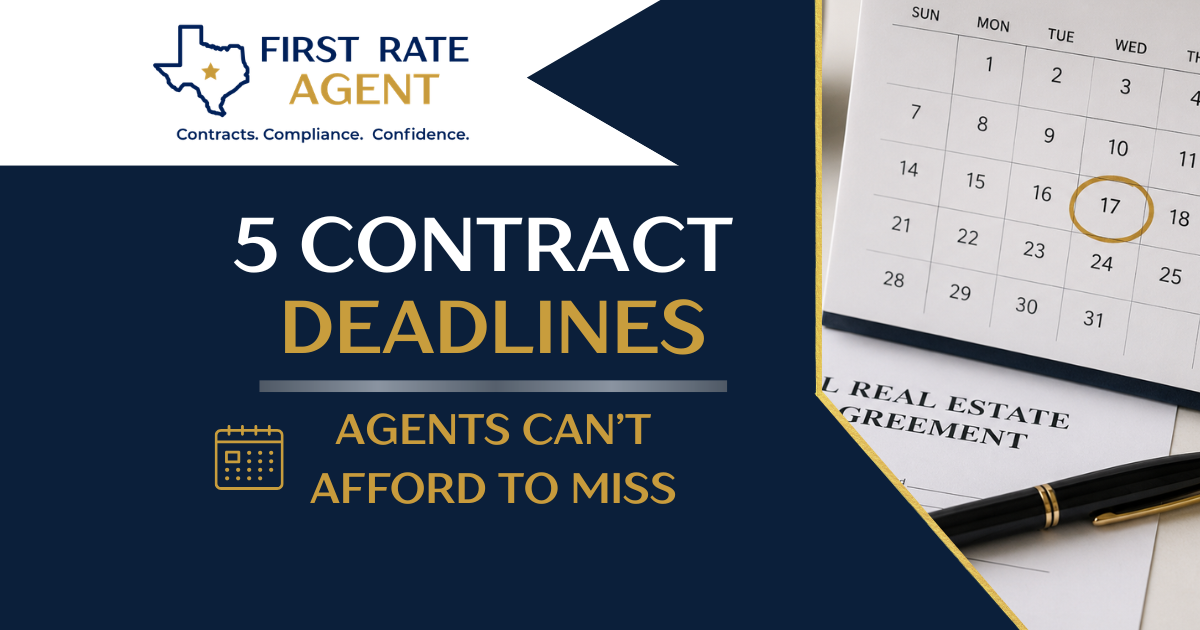
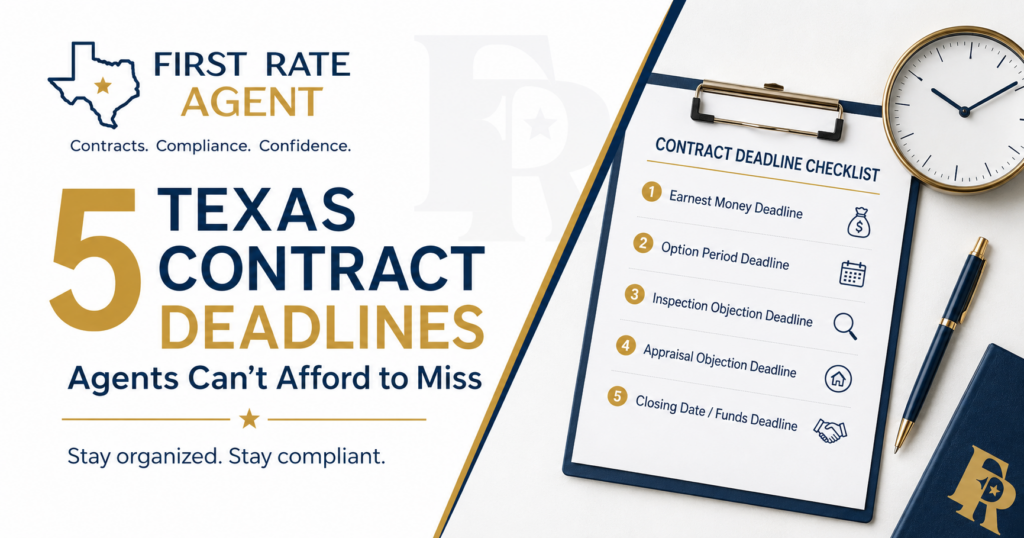
5 Texas Contract Deadlines Agents Can’t Afford to Miss
There are few things more frustrating in a real estate transaction than a problem that could have been avoided with a calendar reminder.
A missed deadline does not always destroy a transaction. But it can absolutely change the client’s leverage, eliminate a buyer’s right to terminate, create unnecessary conflict, or put an agent in the uncomfortable position of explaining why something was not handled on time.
In Texas real estate contracts, deadlines matter. But not all deadlines are created equal.
Some are tied to the Effective Date. Some are tied to the Closing Date. Some depend on when a document is received. Some require written notice. Some require more than just notice. And some are easily overlooked because they live in an addendum rather than the main contract.
Here are five Texas contract deadlines agents cannot afford to miss.
First, Everything Starts With the Effective Date
Before we talk about individual deadlines, we need to talk about the most important date in the contract: the Effective Date. The Effective Date itself is not a deadline. But almost every early contract deadline starts there.
That means that in the rush to get the contract signed, agents need to slow down long enough to confirm the Effective Date is correctly entered on the contract and clearly understood by everyone involved. This is not just an administrative detail. It is the starting line for earnest money, option fee, survey deadlines, financing deadlines, HOA document deadlines, and many other obligations.
REMEMBER: the Effective Date happens when all the contract documents (including all applicable addenda) are fully executed by both sides, all signatures and initials are present, the acceptance is full and unconditional (meaning no write-ins and no lingering, unresolved issues or questions), and finally, when the last party’s acceptance has been communicated to the other side.
A good habit is to create your deadline calendar immediately after the contract is fully executed. Do not wait until the next morning. Do not wait until the title company opens the file. Do not assume someone else is tracking it. Take just a few moments and write down the deadlines while they are still fresh in your mind.
Once the Effective Date is set, the clock is already running on almost every other deadline, on the transaction as a whole, and on the closing.
1. Earnest Money and Option Fee Delivery Deadline
The earnest money and option fee deadline is one of the first major deadlines in most Texas resale contracts.
Under the standard TREC One to Four Family Residential Contract, the buyer must deliver the earnest money and option fee to the escrow agent within three days after the Effective Date. There are extension provisions if the last day of the delivery period falls on a weekend or a legal holiday, which are specifically defined by the contract’s terms.
This deadline matters because the consequences are significant.
If the buyer does not timely deliver the earnest money, the seller has the right to terminate the contract before the buyer delivers the funds. If the buyer does not timely deliver the option fee, the buyer does not have the unrestricted right to terminate under the option paragraph. If the buyer attempts to terminate without a valid right to do so, they likely will lose the earnest money in addition to other possible remedies stated in the contract.
That is not a small issue.
The option period is often the buyer’s most important protection during the inspection period and it is the source of all the buyer’s negotiation leverage with respect to repairs. If the option fee is not handled correctly, the contract is still valid. But the buyer has no right to terminate it under a termination option.
A few practical points for agents:
Confirm where the money must be delivered. Confirm whether the title company accepts electronic payments, checks, or wire transfers. Confirm receipt with the escrow agent and make sure the receipt page of the contract gets executed upon delivery. Do not rely only on the buyer saying, “I sent it.” Sent is not always received.
Also remember that the contract has specific language about weekends and legal holidays for delivery of the earnest money, option fee, and additional earnest money. Do not assume every contract deadline automatically extends just because it falls on a Saturday, Sunday, or holiday. Read the specific paragraph.
Agent habit: As soon as the contract is executed, send the buyer written instructions for earnest money and option fee delivery, then confirm actual receipt with the escrow agent.
2. The Option Period Termination Deadline
The option period is where many agents focus on inspections, repair negotiations, contractor estimates, and amendment language. And of course, all of that matters.
But the most important thing to remember is this: the option period has a specific ending point.
If the buyer wants to terminate under the unrestricted right to terminate, the buyer must give proper notice of termination no later than 5:00 p.m. local time where the property is located on the deadline date.
That 5:00 p.m. deadline catches agents off guard. In fact, it is the only deadline in the real estate transaction using TREC promulgated forms that has a specific time as part of the deadline. Everything else is midnight or “before the end of the day.” But the termination option deadline to terminate is different – 5:00 p.m. local time (where the property is located) on the last day of the option period. And not a moment beyond.
This is especially important when repair negotiations are still floating around late in the option period. A buyer may be waiting for the seller’s response. A seller may be waiting for contractor bids. Agents may be texting back and forth, hoping everyone can work it out.
That is fine, but hope is not a deadline system. If the clock runs out before the buyer sends an executed termination notice, the buyer loses the right to terminate under the (then-expired) termination option.
As a reminder, the termination notice is the buyer’s only recourse under the option period. If the buyer is not comfortable moving forward without an executed amendment, the buyer needs to make a decision before the option period expires. An unsigned repair amendment does not extend the option period. A verbal understanding does not extend the option period. A text saying “we should be okay” does not protect the buyer the same way a timely written termination notice does.
This does not mean agents should push buyers to terminate unnecessarily. It means agents should make sure buyers understand the deadline and the consequences of letting it pass. And buyer agents should be prepared in the event repair negotiations come down to the wire. That may mean that the buyer agent has a signed termination notice in-hand, just in case they need it at the last moment before the deadline expires.
Agent habit: Calendar the option deadline for the actual deadline date and also set a reminder at least one business day earlier. Treat the final day as decision day, not negotiation day.
3. Financing Approval Deadlines
Financing deadlines are often misunderstood because agents tend to think of financing as one general concept. But the Third Party Financing Addendum separates financing approval into different issues – Buyer Approval and Property Approval. Each has its own termination right, and each has its own deadline.
If the contract is subject to Buyer Approval and the buyer cannot obtain that approval, the buyer must terminate within the number of days stated in the addendum. Importantly, the buyer must provide not only notice of termination, but also a written statement from the lender setting forth the lender’s determination.
That second requirement is easy to miss, but here’s an important caveat – if the situation is coming down to the last moment, a buyer agent should not wait to send the termination notice just because the lender has not yet given their written statement. If you find yourself on the client’s last day to terminate for lack of Buyer Approval and the lender has not yet sent their statement, let the listing agent know what’s happening, send the termination notice on its own, and then follow up with the lender’s statement. Better to do that than miss the deadline all together.
Property Approval has its own deadline. If the lender determines the property does not satisfy underwriting requirements, the buyer may terminate on or before the third day before the Closing Date, again with both notice of termination and a written lender statement. If the buyer is using VA or FHA financing, the termination deadline for lack of Property Approval is pushed back to the actual Closing Date.
The financing deadlines are an area where agents can get into trouble by assuming that a financing problem automatically protects the buyer. It simply does not work that way. True, the buyer would not in any event be able to complete the transaction spelled out in the documents because of the financing issue. But what’s at issue with the deadlines is more than that – it’s the buyer’s earnest money.
Bottom line, the contract and financing addendum have to be followed. The correct deadline has to be tracked. The correct notice has to be given. And where the form requires a lender statement, that statement needs to be obtained and delivered along with the termination notice.
This also is why agents should stay in regular communication with the lender throughout the transaction. Do not wait until two days before closing to ask whether underwriting is complete, whether the appraisal is acceptable, or whether repairs are required.
Agent habit: Calendar both the Buyer Approval deadline and the Property Approval deadline immediately upon execution of the contract. Ask the lender early whether there are any borrower approval, appraisal, insurability, or repair issues that could affect the buyer’s ability to close. Stay in touch with the lender.
4. Survey, Title Commitment, and Objection Deadlines
Title and survey deadlines are not always dramatic, but they can become very important very quickly.
The contract contains deadlines for delivery of the title commitment and exception documents. The survey paragraph also requires careful attention because the parties must identify whether the seller is providing an existing survey, the buyer is obtaining a new survey, or the seller is obtaining a new survey.
That selection matters.
Be sure to calendar the survey deadline – whether the seller is supposed to provide an existing survey and the required affidavit or declaration, or the buyer is obtaining a new survey, or the seller is obtaining a new survey. If the seller promises to provide an existing survey and declaration/affidavit and fails to do so, the contract states that the seller will pay for a new survey. If you are the listing agent and you miss that delivery deadline, it could well end up being you paying for the new survey.
Then comes the title objection deadline.
The buyer may have the right to object to certain defects, exceptions, or encumbrances shown in the title commitment, exception documents, or survey. But that right does not stay open forever. The contract requires the buyer to object in writing within the time stated in the contract, which is often a very few number of days. If the buyer misses the objection deadline, the buyer may waive the right to object to certain matters.
That can be a major problem.
This is especially important when the survey reveals encroachments, easements, fence issues, building line problems, or other matters the buyer did not expect. It also matters when the title commitment reveals liens, restrictions, recorded agreements, mineral exceptions, maintenance obligations, or other exceptions that affect the buyer’s intended use of the property.
Obviously, agents cannot act as title attorneys. But agents do need to recognize when a deadline is approaching and when the buyer may need to consult the title company, lender, broker, or an attorney.
Agent habit: Do not simply save the title commitment and survey to the file. Review the deadlines connected to them. Confirm when the buyer received all required documents, then calendar the objection deadline.
5. HOA / Subdivision Information Deadlines
The Addendum for Property Subject to Mandatory Membership in a Property Owners Association (the “HOA Addendum”) is one of the most commonly used addenda in Texas suburban transactions. It also is one of the easiest places to miss a deadline.
The addendum deals with delivery of subdivision information, which generally includes the applicable restrictions, bylaws, rules, and resale certificate. Depending on which box is checked on the addendum, the seller may be responsible for obtaining and delivering the information, the buyer may be responsible for obtaining it, the buyer may have already received and approved it, or the buyer may not require delivery.
Those boxes matter. The HOA Addendum is a very buyer-friendly document, and many of its paragraphs contain termination right for the buyer. If subdivision information is delivered after the contract is signed, the buyer may have a limited window to terminate after receipt. If the information is not delivered as required, the buyer may have other rights under the addendum. If an updated resale certificate is required, that creates its own timing issue.
HOA documents can contain important information: dues, special assessments, transfer fees, leasing restrictions, architectural requirements, pending violations, lawsuits, maintenance obligations, and other material information that can affect the buyer’s decision.
For the buyer, this is not just paperwork. These matters can affect affordability, use, future resale, and whether the property fits the buyer’s needs. Agents must pay close attention to who is responsible for ordering the subdivision information, who is paying for it, whether the title company has the necessary fee, and when the buyer actually receives the documents.
Agent habit: As soon as the contract is executed, review the HOA addendum and confirm who is ordering the documents. Do not assume the title company can order them until the required fee has been paid.
A Simple Deadline System for Every Contract
Contract deadlines are not hard to manage if you build a consistent system. The problem is that many agents try to manage deadlines from memory, text threads, inbox searches, or scattered notes.
That is where mistakes happen.
For every transaction, agents should create a deadline tracker that includes: the Effective Date; the earnest money and option fee deadline; the option period deadline; the additional earnest money deadline, if any; the survey deadline; the title commitment and objection deadlines; the Buyer Approval deadline; the Property Approval deadline; the HOA/subdivision information deadline; the Closing Date; the possession and delivery date; any special provisions, addenda, or negotiated deadlines.
Then add reminders. Not just one reminder on the deadline date. Use multiple reminders: one early reminder, one follow-up reminder, and one final deadline reminder. Let your electronic calendar make some noise and work for you.
The goal is not to make the transaction more complicated. The goal is to make your systems work for you to reduce chaos and provide you the reminders you need at the time you need them.
The Bottom Line
Texas contract deadlines are not suggestions. They are strict legal requirements. They control rights, remedies, leverage, and risk. Missing one can change the entire posture of a transaction.
The best agents do not rely on memory. They use systems. They confirm receipt. They calendar every deadline. They communicate early. And they know when a deadline requires more than just a casual text or verbal update.
A clean transaction file is not just about having documents in the folder. It is about knowing what has to happen next, when it has to happen, and what could be lost if it does not happen on time.
That is the difference between reacting to problems and managing the transaction like a professional.
If you are an agent who feels like every contract turns into a scramble of dates, documents, reminders, and last-minute follow-up, you are not alone. This is exactly where strong transaction systems make a difference.
At Advantage TC, we help Texas agents keep their contract-to-close process organized, deadline-driven, and audit-ready, so nothing important gets lost in the shuffle.
Related Articles
If you found this article helpful, you may also want to read:
The Most Expensive Mistake Agents Make Before They Ever Reach the Closing Table
A practical look at why contract review and file organization need to start before the transaction is already in trouble.
The Most Common Texas Real Estate Contract Mistakes Agents Make
A breakdown of common contract mistakes that can create confusion, delays, and compliance issues.
The Top 5 Contract Addenda Texas Real Estate Agents Should Understand
A guide to the addenda agents see most often and why they matter in everyday Texas transactions.
About Michael Hughes
Michael Hughes is a Texas real estate attorney, broker, educator, and former Managing Broker for eXp Realty Texas, where he oversaw compliance operations for nearly 10,000 agents statewide.
With more than 20 years of legal experience and over a decade in Texas real estate brokerage, Michael helps agents navigate contracts, compliance, risk management, and transaction systems through First Rate Agent and Advantage TC.
Need Help Staying on Top of Transaction Deadlines?
Advantage TC helps Texas real estate agents manage contracts, compliance, deadlines, and transaction coordination from contract to close.