How Texas Agents Can Build an Audit-Ready Transaction File From Day One
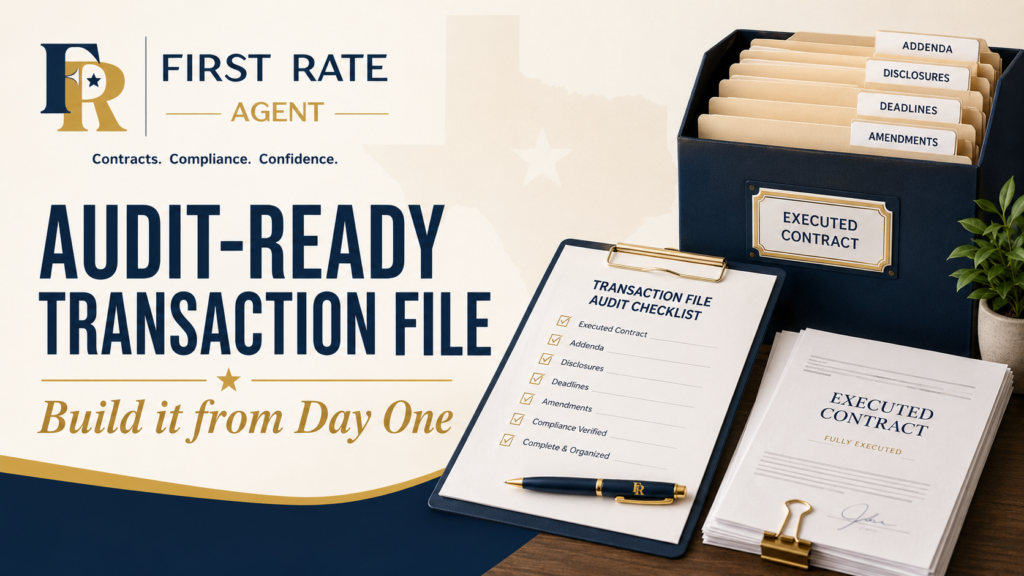
A transaction can close and still leave behind a messy file.
That is something many agents do not think about until later. Sometimes much later.
The buyers got the keys. The sellers got funded. The title company closed the file. Everyone moved on. But from a broker, compliance, or risk-management standpoint, the question is not only whether the transaction closed.
The question is whether the file can be reviewed later and still make sense.
Can someone look at the file six months from now and understand what happened?
Can they see which documents were signed? Can they tell what deadlines applied? Can they verify that notices, disclosures, amendments, and key communications were properly handled?
Can they understand the story of the transaction without calling the agent and asking them to reconstruct everything from memory?
That is the difference between a closed transaction and a clean transaction file.
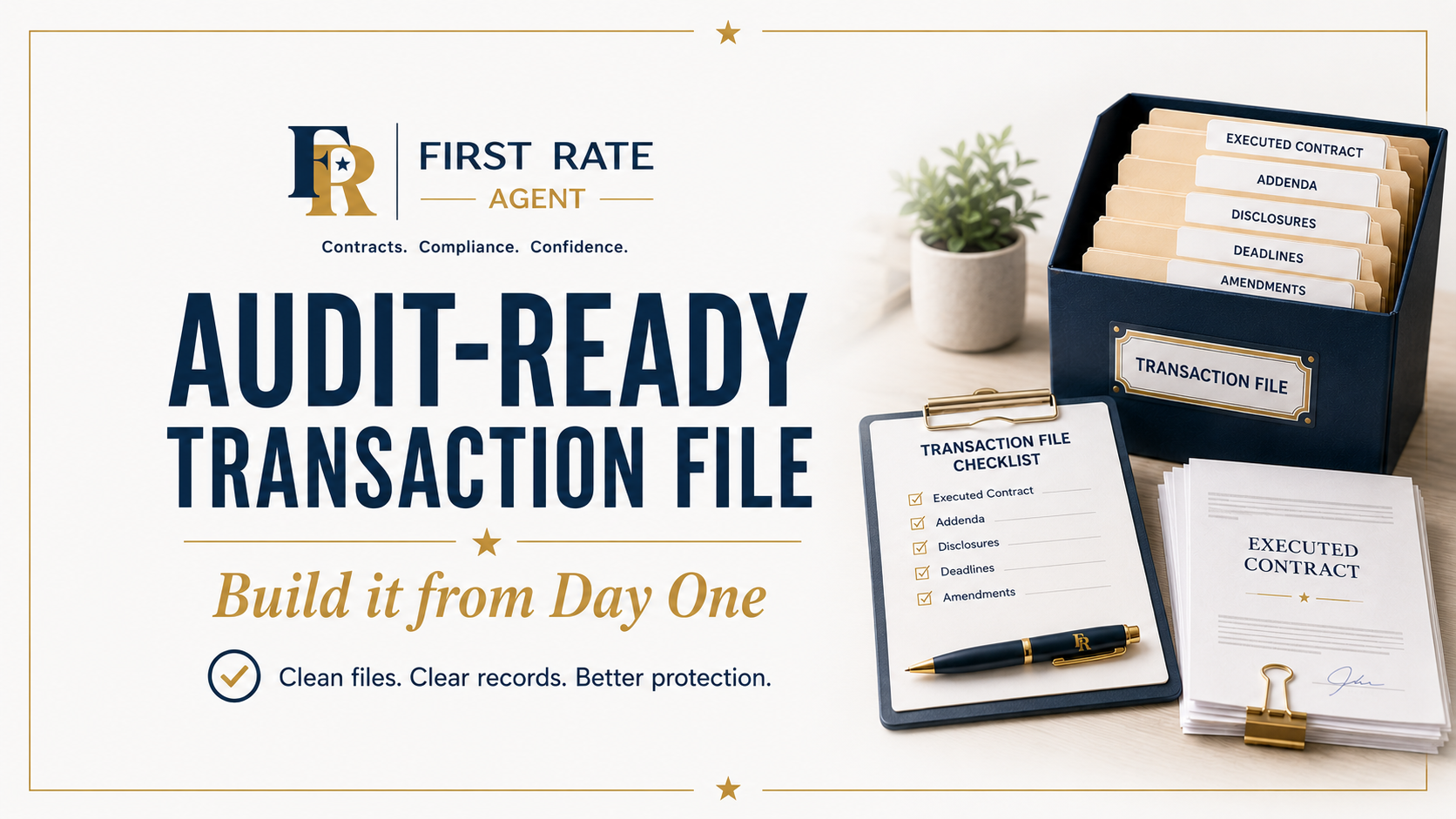
An audit-ready file is not something agents should try to assemble at the end. Successful agents build an audit-ready file from day one.
Why “Closed” Does Not Always Mean “Clean”
A closed file is not automatically a complete file. A real estate transaction may close even if the file is disorganized, missing supporting documents, missing proof of delivery, or difficult to follow.
That does not always create an immediate problem. But it can create problems later.
For example, a broker reviewing the file may not be able to determine whether a required addendum was included. A client may later question when something was delivered. A title, lender, inspection, disclosure, or repair issue may come back up after closing. A TREC complaint may require the brokerage to review the file and explain what happened.
If the file is clean, the review is easier. But if the file is scattered across emails, text messages, downloads, PDFs, e-sign folders, and memory, the review becomes much harder.
That is why file quality matters.
A clean file does not just help the transaction close. It helps the agent, the client, and the brokerage understand and document the transaction after the fact.
Start with the executed contract package.
The foundation of the file is the executed contract package. And while that sounds obvious and simple, this is where many file problems begin.
The contract package should include the fully signed contract and all applicable addenda, notices, disclosures, and related documents that form part of the agreement or support the transaction.
Depending on the transaction, that may include items such as:
- the executed contract
- financing addenda
- appraisal-related addenda
- other required addenda for that transaction
- seller’s disclosure notice
- HOA or property owners’ association documents
- lead-based paint documents, if applicable
- non-realty items addendum
- temporary lease forms
- backup contract documents
- compensation-related documents required by your broker
- buyer or seller representation documents
- broker-required internal documents
- any transaction-specific notices or disclosures
- substantive communications concerning the transaction
The key is not to throw every possible form into every file. The key is to make sure the documents in the file match the transaction and tell the story of what happened.
If an addendum applies, it should be included. If a notice was required, it should be saved. If the broker requires a document, it should be in the file. If something was sent for signature, the final signed version should be easy to find.
A file reviewer should not have to guess whether a form existed, whether it was signed, or whether it applied in that deal.
Track deadlines in writing.
Deadlines do not belong in your head. They belong in writing.
This is one of the most important habits agents can develop if they want cleaner files.
Real estate transactions move quickly. Between the client, the other agent, the lender, the title company, inspectors, appraisers, contractors, and the broker, there are too many moving parts to rely on memory.
At a minimum, agents should have a written system for tracking key dates and deadline-related items, such as:
- effective date
- earnest money delivery
- option fee delivery
- additional earnest money, if applicable
- option period deadline
- financing deadlines
- appraisal-related deadlines
- seller’s disclosure notice timing
- HOA or resale certificate issues
- title commitment and exception documents
- survey and attestation document delivery
- title objections
- notice deadlines
- amendment deadlines
- repair completion
- temporary lease dates
- closing date
- possession timing
- funding and delivery of keys
- broker file review requirements
Not every transaction will have every deadline. But every transaction should have a written deadline review.
A deadline tracker does more than remind the agent what to do next. It also helps document how the agent managed the file.
If someone reviews the file later, a good tracker can help show what dates mattered, what tasks were monitored, and what follow-up items were handled.
That is especially important when a deal becomes complicated.

Save proof of delivery.
One of the most common weaknesses in a transaction file is the lack of proof showing what was delivered, when it was delivered, and to whom it was delivered.
This matters because many transaction issues are not just about whether a document existed. They are about whether the right person received it at the right time.
For example, the file may need to show delivery of:
- executed contract documents
- option fee or earnest money confirmations
- amendments
- notices
- termination documents
- seller’s disclosure notice
- HOA documents
- title commitment and exception documents
- survey documents
- repair documents
- lender or title requests
- client instructions
- important transaction communications
A clean file should not rely on “I know I sent it.” It should show the actual delivery.
That may mean saving email confirmations, platform delivery receipts, signed acknowledgments, electronic signature certificates, title company confirmations, or other written evidence that supports the timeline of the transaction.
Agents should also be careful with text messages.
Texts can be useful for quick communication, but they are not always easy to retrieve, organize, or review later. This is especially true of proprietary text platforms, such as Messenger, WhatsApp, Telegram, and Signal. If an important instruction or notice is discussed by text, consider whether it also needs to be confirmed or documented in a more file-friendly way (such as email), consistent with your broker’s policies.
The goal is simple: if a document or communication matters, the file should make it easy to prove what happened.
Keep amendments and changes organized.
Most transactions evolve. The contract is signed, then something changes.
The buyer asks for repairs. The seller agrees to a concession. The closing date changes. The lender needs an extension. A temporary lease is added. A non-realty item becomes part of the deal. A title issue requires a document. A deadline gets moved.
Those changes need to be organized and documented. A clean file should show the evolution of the deal and how it changed from the effective date to the closing.
That means amendments and related documents should be saved in a way that makes the transaction history clear. The file should be able to tell the story.
For example, a reviewer should be able to tell:
- what the original contract said
- what was later changed
- when the change was signed
- who signed it
- what deadline or obligation was affected
- whether the change required follow-up
- whether the file’s deadline tracker was updated
This is where file organization matters the most. If amendments are scattered in email attachments, e-sign folders, downloads, and random PDF names, the file becomes harder to review.
Use clear file names that can be searched. Save final signed versions. Keep related documents together. Update the deadline tracker when a date changes.
After all, a contract amendment is not just another PDF. It may change the entire timeline or structure of the transaction.
Keep client instructions and substantive communications.
Not every communication needs to be saved forever in the front of the file. But TREC rules require that substantive communications (things like client instructions, transaction decisions, important details about the transaction) be documented, captured, and preserved in the file.
For example, if a client instructs you to submit an offer with certain terms, accept a counteroffer, request repairs, waive an issue, extend a deadline, terminate, or proceed despite a known concern, that instruction may matter later. Your negotiations with the other agent are substantive. Your communications with third parties in the deal, such as the title agent, lender, inspector, etc. are all substantive.
The file should reflect important decisions and the conversations that were part of those decisions.
This does not mean turning every conversation into a legal memo. But it does mean being intentional about documenting and preserving key communications.
A simple email confirmation can often do a lot of work:
“Just confirming that you would like us to submit the offer with the terms discussed…”
“Confirming that you have decided to move forward with the amendment as drafted…”
“Confirming that you do not want to request repairs beyond the items listed…”
“Confirming that you understand the deadline and want to proceed…”
The file should not depend entirely on memory. Memory fades. Written records help.
Use a file review checklist before the file gets messy.
Many agents think of file review as something that happens near closing or after closing.
That is too late.
A file review checklist is most useful when it is used early and repeatedly.
The first review should happen when the file is opened. That is when the agent can confirm that the executed contract package is complete, the right addenda are attached, deadlines are identified, and missing documents are requested before the transaction gets chaotic. It’s best to do it while the details are fresh in your mind.
The second review should happen during the transaction, especially after amendments, repairs, financing issues, title issues, or other changes.
The final review should happen before closing or immediately after closing, depending on the brokerage’s process.
A simple file review checklist can help agents ask:
- Do we have the fully executed contract?
- Are all required addenda included?
- Are disclosures and notices saved?
- Are deadlines tracked?
- Are amendments organized?
- Are key communications documented?
- Are delivery confirmations saved?
- Are broker-required documents complete?
- Are compensation-related documents handled according to broker policy?
- Would this file make sense to someone reviewing it later?
The point is not to create busywork. The point is to prevent a messy file from becoming a bigger problem.
The Broker-Review Test
Here is a simple test for whether your file is audit-ready:
Could your broker review this file six months from now and understand what happened without calling you?
If the answer is yes, the file is probably in good shape. If the answer is no, the file may need work.
A broker should be able to open the file and see the story of the transaction. Just from the materials in the file.
The executed contract package should be clear. The addenda should be complete. The disclosures should be saved. The deadlines should be identifiable. The amendments should be organized. The key communications should be documented and preserved. The delivery records should be available. The final file should show how the transaction moved from contract to closing.
That does not happen by accident. It happens because the agent builds the file intentionally from the beginning.
What an Audit-Ready File Helps Protect
An audit-ready file helps protect more than compliance.
It also helps protect the agent’s time. When the file is clean, the agent does not have to dig through emails and downloads to find missing documents later.
It helps protect the client experience. When the agent is organized, the client receives better communication, clearer follow-up, and fewer surprises.
It helps protect the brokerage. A clean file makes broker review easier and reduces the risk of missing documents or unexplained gaps.
It also helps protect the transaction. When deadlines, notices, amendments, and communications are tracked properly, the agent is less likely to miss something important.
A clean file is not just about passing review. It is about running a better, more professional transaction.
Build the file as you go.
The best time to clean up a transaction file is not at the end. It is as the transaction unfolds.
Save documents when they are signed.
Track deadlines when the effective date is set.
Track changes as they occur.
Document delivery when something is sent.
Update the file when an amendment is signed.
Save confirmations when key items are completed.
Review the file before it becomes urgent.
That approach takes discipline and a process, but it is easier than trying to reconstruct the file at the end.
A file built as you go is almost always cleaner than a file assembled after the fact.
The Real Takeaway
An audit-ready transaction file is not just a compliance project. It is a professional habit of highly successful agents.
Texas agents who build clean files from day one are better prepared for broker review, client questions, transaction disputes, and post-closing issues.
Audit-ready files also are easier to work with. A clean file shows that the agent is not just focused on getting the contract signed. The agent is actively managing the transaction.
That is the difference.
The goal is not just to close. The goal is to close with a file that makes sense later.
Related Articles
If you found this article helpful, you may also want to read:
How Texas Agents Should Clean Up Their Offer Templates After a TREC Form Change
A practical guide to finding and removing outdated contract forms, saved offer packets, e-sign templates, addenda bundles, and workflow shortcuts after a TREC form change.
July 1 TREC Contract Changes: 5 Things Texas Agents Should Check Before Writing Their Next Offer
A detailed look at how extensive TREC form changes create file-quality issues along with changes to the forms themselves.
The Hidden Liability of Text Messages in Real Estate Transactions
A clear-eyed look at the potential dangers of text messaging in real estate transactions and thoughts on how to capture and preserve substantive communications.
About Michael Hughes
Michael Hughes is a Texas real estate attorney, broker, educator, and former Managing Broker for eXp Realty Texas, where he oversaw compliance operations for nearly 10,000 agents statewide.
With more than 20 years of legal experience and over a decade in Texas real estate brokerage, Michael helps agents navigate contracts, compliance, risk management, and transaction systems through First Rate Agent and Advantage TC.
Need Help Building Audit-Ready Transaction Files?
Clean transaction files do not happen by accident. They come from organized documents, reliable deadline tracking, proof of delivery, preserved communications, and a system that makes the file easier to review later.
If your transaction files are scattered across email, e-sign platforms, cloud folders, text messages, and downloads, Advantage TC can help you put a cleaner contract-to-close process in place.
A well-managed file does not just make closing easier. It makes the transaction easier to review, explain, and defend later.