Why Clicking “Send” Is Not the End of the Job in a Texas Real Estate Transaction
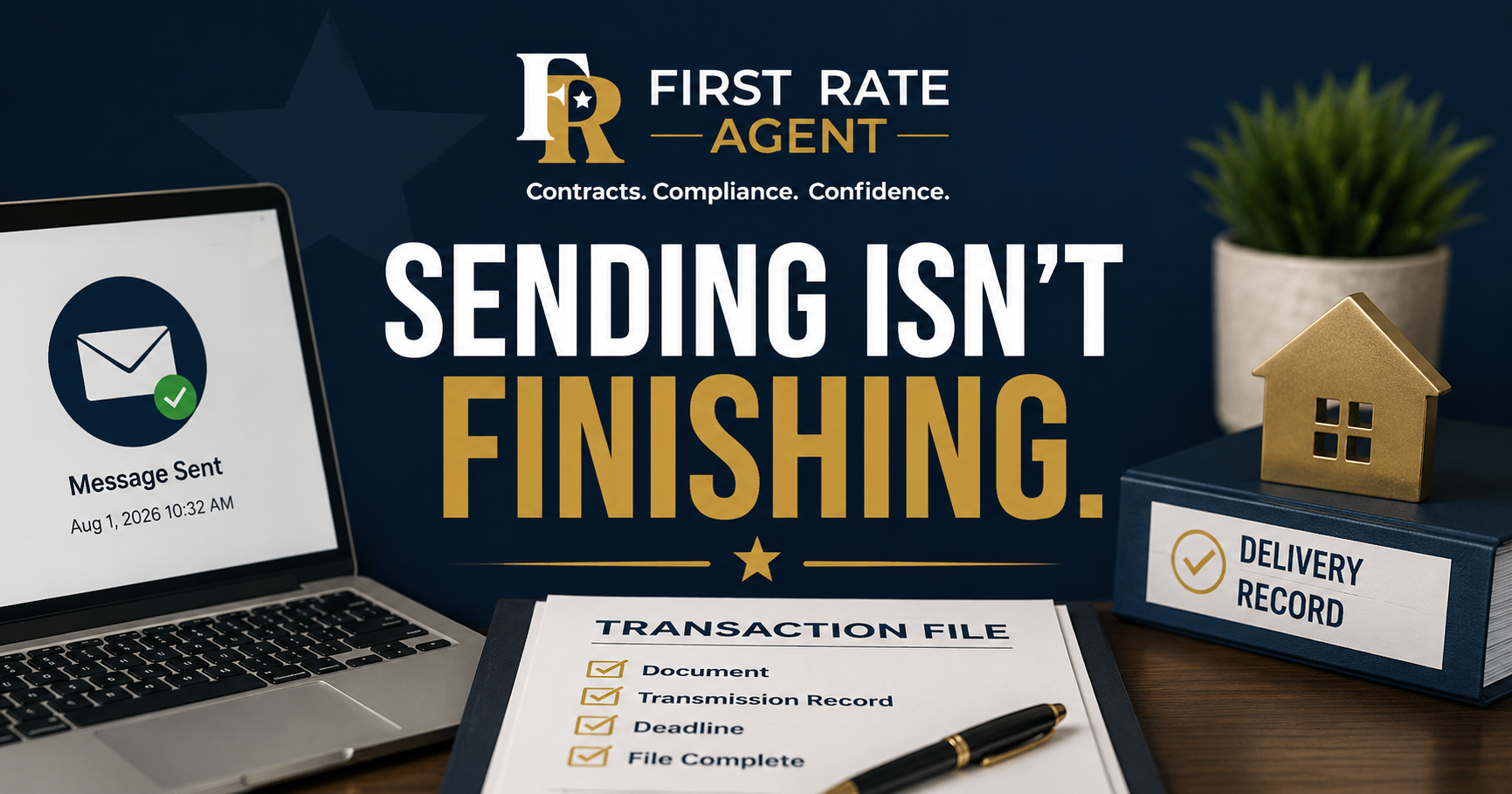
Clicking Send can feel like finishing the job. The amendment is attached. The notice is in the email. The disclosure has left your inbox. The e-signature invitation has gone out.
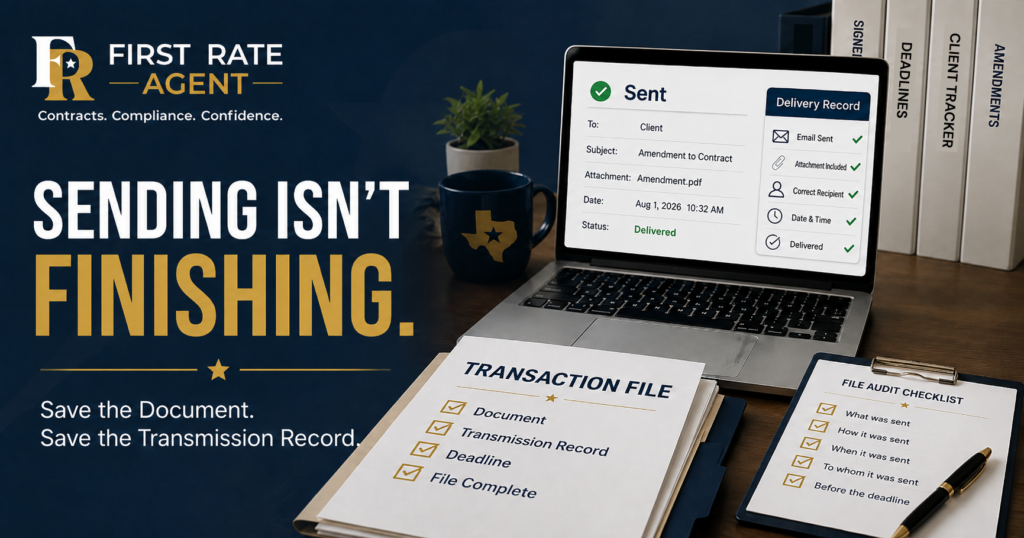
But clicking Send does not finish the file-management process.
A clean transaction file should answer more than just one question: Did the agent transmit the correct document through an authorized method?
It should also help answer:
- What was transmitted?
- Which version was transmitted?
- When was it transmitted?
- How was it transmitted?
- To whom was it transmitted?
- Did the method comply with the contract?
- Did the transmission occur before the applicable deadline?
- Can someone verify all of that later?
Those questions matter because the document and the transmission record serve different purposes. The document shows what was signed, disclosed, requested, amended, or noticed. The transmission record helps show what happened to the document afterward.
Texas agents should preserve both.
Start With the Contract, Not a General Rule
Before discussing transmission records, one distinction is critical: The controlling contract determines when and how a particular notice becomes effective. It’s not some general rule of thumb that controls.
In the current TREC One to Four Family Residential Contract, Form 20-19, Paragraph 21 requires notices from one party or that party’s agent to the other to be in writing. It further provides that notices are effective when mailed, hand-delivered, sent by overnight courier, or transmitted electronically to the other party or that party’s agent.
Accordingly, the effectiveness of a notice does not always depend on proof that the recipient opened, read, or acknowledged it. Under the applicable contract, the critical question may be whether the notice was properly transmitted through an authorized method to the correct party or agent.
But that does not eliminate the need to preserve evidence. If fact, it makes the record even more important.
If effectiveness of a notice depends on properly transmitting it, the file should help establish exactly what was transmitted, when it was transmitted, where it was transmitted, and whether the contract recognized that method.
This article addresses how agents can build that record. It does not replace the applicable contract, broker policy, or legal guidance when a delivery question arises.
The Document and the Transmission Record Are Not the Same Thing
Suppose a buyer signs a termination notice before a contractual deadline. That signed notice proves what the buyer authorized.
But it does not necessarily prove:
- when the notice left the agent’s control
- which address or account the agent used
- whether the correct attachment accompanied the message
- whether the transmission occurred before the deadline
- whether the method complied with the contract
- whether the message went to the correct party or agent
The transmission record helps answer those questions.
Similarly, an executed amendment proves the terms that the parties signed. But it does not, by itself, show when the amendment reached the transaction participants who needed to receive it.
The file may need both:
- the final document, and
- the record showing how the document moved through the transaction.
One does not replace the other.
“I Know I Sent It” Is Not a File Record
During an active transaction, an agent may remember exactly what happened. They may clearly remember drafting the email, attaching the document, selecting the recipient, and pressing Send at 4:42 p.m.
But months later, those details probably won’t be as clear.
The message may be buried among thousands of emails. The attachment may no longer be easy to identify. The agent may have used a phone, an app, a transaction platform, or a personal inbox. The recipient’s address may have been typed manually. Several versions of the same document may exist.
A transaction file should not depend on memory. It should preserve enough information for a later reviewer to reconstruct the event without relying on the agent’s recollection.
What a Transmission Record May Look Like
No single record or delivery method fits every situation.
Depending on the document, the contract, the transmission method, and the brokerage’s procedures, the file may preserve:
- the sent email showing the date, time, recipients, subject line, and attachment
- an email transmission or delivery confirmation
- an e-signature completion certificate or audit trail
- a transaction-platform activity record
- a portal upload or transmission confirmation
- a written acknowledgment from the recipient
- a title company confirmation
- an exported record of a substantive text exchange
- a broker-approved communication log
- a follow-up email confirming an earlier transmission
- another reliable record created through the transmission process
The strongest evidence is usually the evidence created at the time of transmission. A contemporaneous sent-email record generally tells a clearer story than a note added weeks later stating, “Document sent Tuesday.”
The later note may help. But the original transmission record usually provides more useful detail.
Preserve the Complete Sent Email
Saving only the attachment may leave an important gap. When email is used, preserve the complete sent message whenever the transmission matters.
The saved record should show:
- the sender
- every recipient
- the date and time
- the subject line
- the body of the message
- the identity of the attachment
- any response or acknowledgment that matters
Be careful about saving a printed email that omits the attachment name, complete recipient information, or timestamp.
We need to prove more than the fact that an email message exists. The goal is to connect the correct document with the correct transmission.
A record that says “Please see attached” is much less useful if the file cannot show what was attached.
Confirm That You Transmitted the Correct Document
A transmission record proves only what it actually proves. It may establish that an email was sent at a certain time. It does not automatically establish that the correct document accompanied it.
Common mistakes include:
- attaching an unsigned draft
- attaching the wrong amendment
- transmitting an outdated version
- omitting one or more pages
- attaching a document from another transaction
- forwarding a prior email without the intended attachment
- sending an e-signature invitation instead of the completed document
- transmitting the document to an incorrect address
- sending only a link that later expires
Before pressing Send, pause long enough to verify:
- The document is final.
- The required signatures are complete.
- Every page is included.
- The file belongs to the correct transaction.
- The recipients are correct.
- The delivery method complies with the contract and broker policy.
That brief review can prevent a much larger problem.
An E-Signature Invitation Is Not Necessarily the Record You Need
E-signature platforms are valuable transaction tools.
But agents should distinguish among:
- an invitation to sign
- a completed signature event
- a completed-document notification
- transmission of the final executed document
- the platform’s audit trail
- contractual delivery of a notice or other document
Each of those events may occur at different times.
An invitation to sign shows that the platform generated or transmitted access to a document for signature. It may not establish that the final, completed document was later transmitted through the method required by the contract.
Likewise, a completion certificate may document the signing process without answering every contractual-notice question.
Do not assume that the platform automatically preserves every record the brokerage will need.
Review the completed transaction file, and save the relevant documents and audit records while they remain readily available.
Text Messages Deserve Extra Care
Texts are fast, familiar, and easy to use. But they can also be difficult to organize and preserve.
A text thread may show that a document was sent, but the record may not clearly identify:
- the recipient
- the full date and time
- the attachment
- the document version
- the complete context
- whether the message was exported accurately
- whether the contract permitted that transmission method
A link sent by text may later stop working. A screenshot may omit the contact information, timestamp, or prior messages. A message may remain only on the agent’s personal phone.
When a transmission is important, use a method authorized by the contract and consistent with broker policy. Preserve the communication in a file-friendly format.
When appropriate, a follow-up email may help: Confirming that I sent the signed amendment to you by text at 2:14 p.m. today. I have attached another copy here for your records.
That email does not retroactively change the contract’s requirements. But it may strengthen the transaction record by preserving the context and attaching the document in a searchable format.
Paragraph 21 Should Not Be Treated as Boilerplate
The notice paragraph deserves attention when the contract is prepared.
TREC has emphasized that Paragraph 21 should be completed fully and accurately so the parties know where notices should be sent or delivered in order to be effective.
Agents should not wait until a deadline is approaching to discover that:
- an email address is missing
- an address contains a typo
- the wrong agent information appears
- a party has not provided usable contact information
- the intended transmission method is unclear
- a saved template contains outdated information
Review Paragraph 21 when preparing the contract. Then when sending a notice use the information that the parties placed in the contract.
A good delivery workflow cannot correct a notice paragraph that was never completed properly.
Deadline-Sensitive Documents Deserve Special Attention
Not every document carries the same level of risk. A routine informational email may not require the same documentation as a time-sensitive notice. Some communications are simply more important than others.
Give extra attention to documents involving:
- termination rights
- option-period decisions
- title or survey objections
- lender or appraisal contingencies
- amendment deadlines
- repair negotiations
- disclosures
- contingency removals
- closing extensions
- possession matters
- demands, objections, or elections
- any other communication that may affect a contractual right or deadline
When timing matters, preserve the transmission record promptly. Do not leave it buried in an inbox with the intention of organizing the file later.
Later may be after the deadline, after a dispute begins, or after the record becomes difficult to retrieve.
Save the Document and the Transmission Record Together
A simple file-naming system can make later review much easier.
For example:
2026-08-05 — Amendment 1 — Executed
2026-08-05 — Amendment 1 — Transmission Email
Or:
Buyer Termination Notice — Signed
Buyer Termination Notice — Sent 2026-08-07 at 3-42 PM
The exact naming convention matters less than consistency.
A reviewer should be able to locate the document and its transmission record without searching several systems.
A well-organized transaction folder may place these items together:
- final signed document
- sent email or transmission record
- acknowledgment, when relevant
- platform certificate, when relevant
- related deadline entry
- follow-up communication, when relevant
This approach allows the file to tell the complete story.

Do Not Leave the Record in a Personal Inbox
An agent’s inbox is a communication tool. It should not be the brokerage’s only transaction archive.
TREC requires brokers to maintain eight specified categories of records for at least four years from the closing or termination of a contract. The records must be kept in a format that can be readily made available to the Commission.
Brokerage procedures may require agents to upload correspondence, notices, amendments, disclosure records, and other materials into a central system.
It is important to follow those procedures.
A record that exists only in an agent’s personal email account may become unavailable if the agent changes platforms, leaves the brokerage, loses access, deletes the message, or replaces a device.
A broker-reviewable file should not depend on continued access to one person’s inbox.
Common Transmission-Record Mistakes
Agents can improve their files by avoiding several recurring mistakes.
• Saving the document but not the transmission
The file contains the signed notice, but nothing shows when or how it was transmitted.
• Saving the email but not the attachment
The message says “attached,” but the file does not connect the email with the document.
• Preserving only a screenshot
The screenshot omits the recipient, complete timestamp, attachment, or surrounding context.
• Assuming the e-signature platform handled everything
The platform documents the signatures, but the file does not establish contractual delivery.
• Sending to an address that is not in the contract
The agent uses a familiar email address without checking the notice information.
• Transmitting the wrong version
The transmission record is complete, but the attachment is an unsigned or outdated draft.
• Waiting until closing to organize the file
By then, transmission records may be difficult to identify, export, or match with the correct documents.
• Treating an acknowledgment as the only evidence
A reply saying “received” may help, but the file should still preserve the original transmission and attachment.
• Assuming silence means the notice was ineffective
Under Paragraph 21 of the current One to Four Family Residential Contract, a written notice is effective when transmitted through one of the stated methods to the other party or that party’s agent. The form does not make effectiveness depend on a reply or acknowledgment.
Build the Transmission Record Into the Workflow
Proof becomes easier to preserve when it is part of the process rather than an end-of-file cleanup project.
A practical workflow might look like this:
- Review the contract’s notice provisions.
- Verify the recipient information.
- Confirm that the document is final and complete.
- Use an authorized transmission method.
- Send the correct attachment.
- Preserve the transmission record immediately.
- Save any relevant acknowledgment or platform audit trail.
- Upload the document and transmission record to the transaction file.
- Confirm that the transmission occurred before the deadline.
- Record the completed task in the deadline system.
This process takes only a few additional minutes when performed consistently. Reconstructing the same record months later can take much longer—and may not be possible.
The Broker-Review Test
Here is the practical test:
Could your broker review the file six months from now and determine what was transmitted, when it was transmitted, how it was transmitted, and who received it?
The reviewer should not need to:
- search your personal inbox
- scroll through your phone
- guess which attachment you used
- compare several unsigned drafts
- rely on your memory
- contact the recipient to reconstruct the timeline
The transaction file should supply the answer by itself. If it cannot, the file may contain the document without containing the complete transmission record.
The Real Takeaway
Clicking Send is not the end of the job.
Under the current TREC One to Four Family Residential Contract, written notices are effective when mailed, hand-delivered, sent by overnight courier, or electronically transmitted to the other party or that party’s agent.
That makes accurate documentation essential.
The file should preserve:
- the correct final document
- the applicable recipient information
- the method of transmission
- the date and time transmitted
- the attachment or complete document
- any relevant confirmation or audit trail
- the connection to the applicable deadline
The document shows what the parties signed or what a party communicated.
The transmission record helps show what happened next.
A clean transaction file needs both.
Related Articles
If you found this article helpful, you may also want to read:
How Texas Agents Should Confirm Client Instructions in Writing
A practical guide to confirming important client instructions in clear, simple, written language so the client’s decision, the agent’s next step, and the applicable deadline remain easy to understand and review later.
What Texas Agents Should Preserve in the Transaction File
A clean transaction file should preserve more than signed PDFs, including client instructions, proof of delivery, deadline records, amendments, and key communications that may need to be reviewed later.
How Texas Agents Can Build an Audit-Ready Transaction File From Day One
A practical guide to building cleaner, more reviewable transaction files from day one by organizing signed documents, deadlines, proof of delivery, amendments, and key communications before the file gets messy.
About Michael Hughes
Michael Hughes is a Texas real estate attorney, broker, educator, and former Managing Broker for eXp Realty Texas, where he oversaw compliance operations for nearly 10,000 agents statewide.
With more than 20 years of legal experience and over a decade in Texas real estate brokerage, Michael helps agents navigate contracts, compliance, risk management, and transaction systems through First Rate Agent and Advantage TC.
Need Help Keeping Every Transaction Organized and File-Ready?
Advantage TC supports Texas real estate agents with contract-to-close coordination, deadline tracking, document organization, and transaction-file management.
You remain in control of the client relationship while a structured coordination system helps keep the transaction moving and the file ready for review.