The Amendment Is Signed. Now What? How Texas Agents Should Update the Transaction After a Contract Change
Successfully negotiating a contract amendment can feel like crossing a finish line.
The parties agreed. The document was signed. The amendment went into the file.
All done, right? Not necessarily.
A signed amendment changes the parties’ agreement, but it does not automatically update the rest of the transaction. Calendars do not revise themselves. Transaction checklists do not know that the closing date moved. The lender, title company, transaction coordinator, or other participants may still be working from the original terms unless someone communicates the change.
That is why every amendment should trigger a simple operational question:
What else in the transaction needs to change because the contract changed?
For Texas agents, the practical lesson is straightforward:
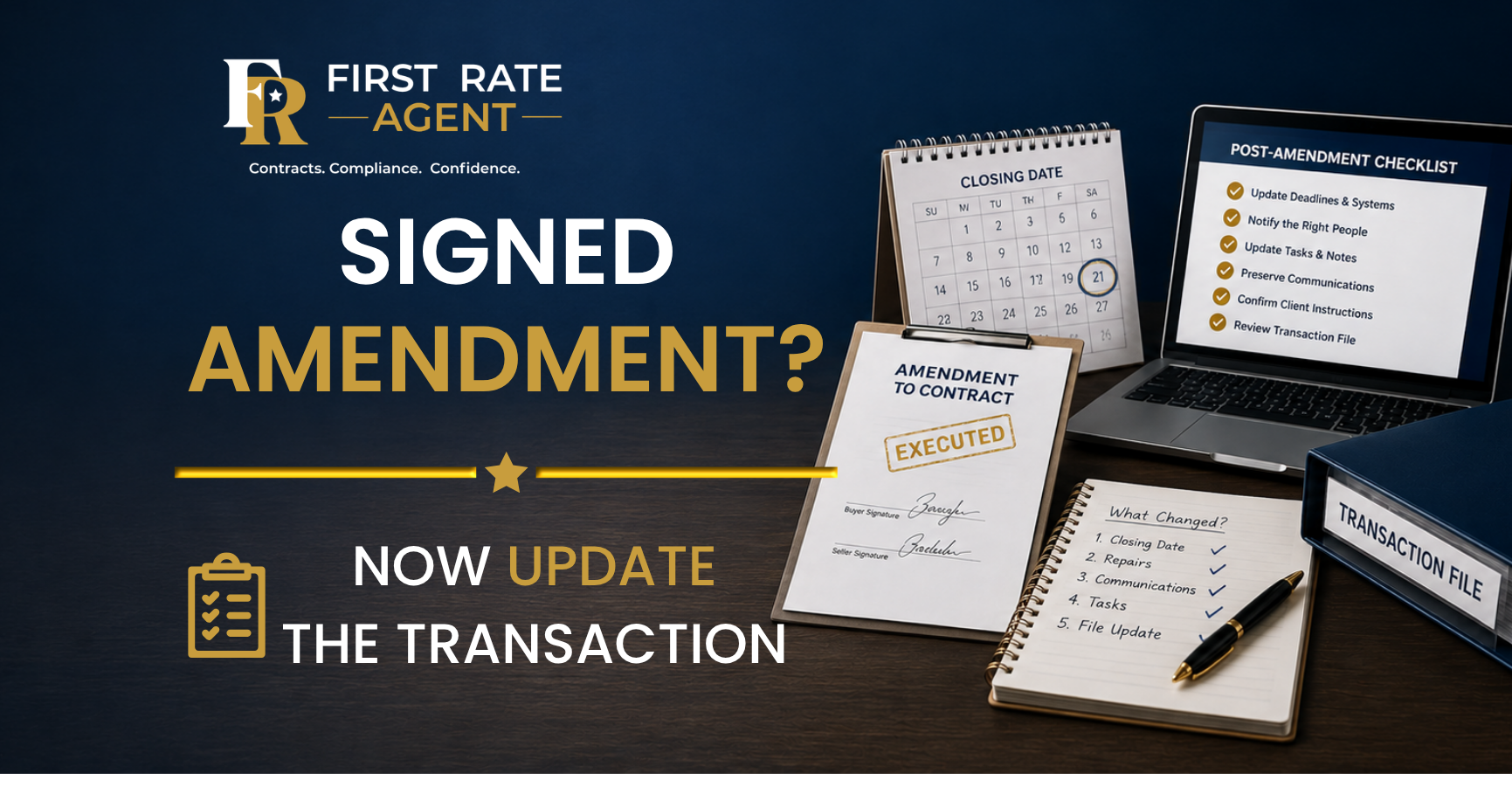
Contract change → system change. Or even better, a system UPDATE.
The promulgated amendment form may be used to change or add terms to an already-executed contract. Depending on the transaction, those changes can affect dates, money, repairs, financing-related provisions, obligations, and the workflow surrounding the deal.
Getting the amendment signed is definitely important. But from a transaction-management standpoint, however, it is often only the trigger for a series of next steps.
Start With Exactly What Changed
Before updating anything else, identify the amendment’s actual effect. What exactly has changed?
A repair amendment requires different follow-up from a closing-date extension. A sales-price change may affect financing and closing documents. Another modification may create a new task without changing a single calendar date.
So start with the executed amendment and ask yourself what does this change:
- Contractual date?
- Monetary term?
- Repair obligation?
- Financing-related provision?
- Did the amendment create a new task?
- Did it eliminate or modify an existing task?
- Does someone else involved in the transaction need the updated information?
Do not update the transaction based on what everyone remembers discussing. Update it based on what the parties actually executed in the written document.
1. Update the Deadline System
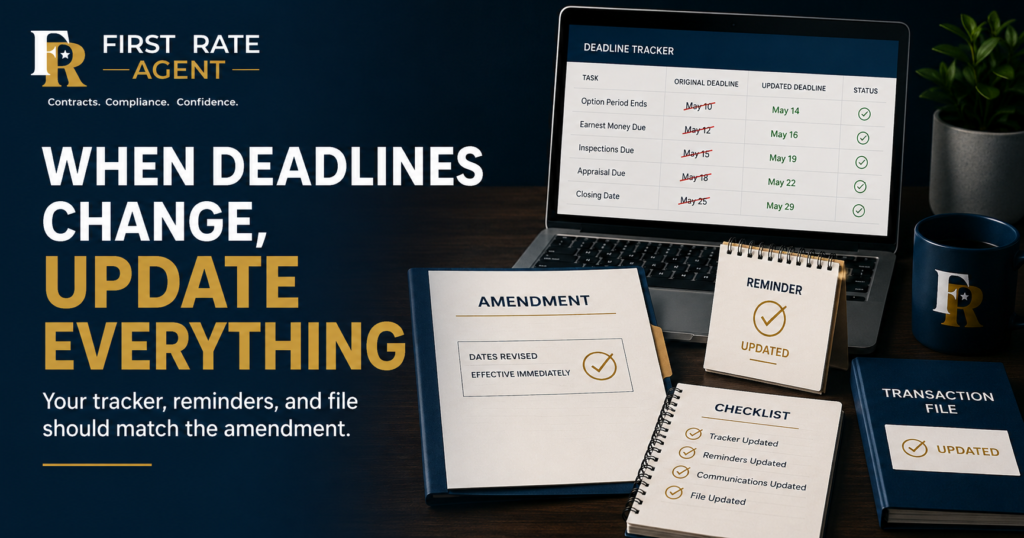
If an amendment changes a contractual date, the corresponding deadline system should change with it. This sounds obvious, but it is one of the easiest places for transaction management to break down.
Suppose the parties amend the closing date.
The contract may now show the correct date, while everything else in the agent’s world still shows the old one. Think about things like the agent’s:
- calendar,
- CRM,
- transaction-management platform,
- task list,
- reminder system, or
- team checklist
Now the transaction has two competing versions: the contract says one thing, while the operating system says another.
Update the relevant systems promptly after receiving the fully executed amendment. Determine if this particular change has any “ripple effects” that may change other contractual obligations or deadlines. Then consider whether the changed date affects other reminders or internal tasks.
For example, a new closing date may affect internal scheduling for the final walkthrough, utility coordination, document review, lender follow-up, or closing communications. Internal activities like those are not necessarily contractual deadlines. But they may depend on a contractual date.
2. Identify Who Needs the New Information
An executed amendment sitting in the transaction file does not communicate itself.
An important question to ask is: Who is currently relying on the contract term that just changed?
Depending on the amendment, that could include:
- the buyer,
- the seller,
- the other agent,
- the title company or escrow agent,
- the lender,
- the transaction coordinator,
- members of the agent’s team, or
- another professional involved in carrying out the revised agreement.
Not every amendment needs to be e-mail blasted to everyone involved in the deal. But for those who need to know about the change, it’s important to notify them promptly.
Communicate based on relevance.
If the closing date changes, the title company and lender may need the revised information. If the sales price changes, financing and closing participants may need updated documentation. If the parties agree to repairs, those responsible for arranging, completing, or documenting the work may need to know what was agreed.
So instead of stopping at: “Did I send the amendment?”
Ask yourself: “Did the people who need the changed information receive it?”
3. Update the Tasks That Depend on the Changed Term
An amendment may create a ripple effect even when it changes only one provision of the agreement.
Consider an amendment involving repairs.
Once the parties reach a written agreement, the workflow may now include tasks such as:
- monitoring completion,
- coordinating access,
- obtaining appropriate documentation,
- tracking receipts or invoices when relevant,
- preparing for the final walkthrough, or
- preserving evidence showing how the agreed work was handled.
Similarly, a closing-date amendment may affect internal scheduling, lender coordination, title work, or client communications.
This is where a strong transaction system separates contract terms from tasks generated by those terms.
The amendment tells you what the parties agreed to. Your workflow should identify what needs to happen next because of that agreement.
4. Retire the Old Assumption
One of the quieter risks after an amendment is that the original term continues to live in calendars, notes, emails, and team communications.
For example, the amended contract may now say closing is September 18.
But an earlier email says September 12. The agent’s calendar still says September 12. The transaction coordinator’s checklist says September 12. The client may still be planning around September 12 – movers, utilities, etc.
The old information does not disappear simply because the parties amended the contract. Part of the post-amendment process therefore should be identifying where the prior term is still being used operationally and making the revision.
That does not mean deleting the transaction’s history. In many cases, the better approach is to preserve the history while making the current status unmistakable. For example:
Original Closing Date: September 12
Amended Closing Date: September 18
We don’t want to pretend the original agreement never existed. The goal is to capture what actually happened and to prevent anyone from continuing to operate from outdated information.
5. Preserve the Amendment—and the Important Communications Around It
The executed amendment belongs in the transaction file. But the surrounding record may need attention and preservation too.
TREC record-retention requirements include contracts and related transaction records, as well as substantive communications with parties to a transaction. From a practical file-management perspective, that means the file should often show more than the final PDF when the surrounding communications help explain what happened.
Depending on the transaction, the file may appropriately include:
- the fully executed amendment,
- relevant client instructions,
- transmission of the amendment,
- substantive communications concerning the change, and
- documentation showing how the transaction proceeded afterward.
When preserving substantive communications, we don’t have to save every routine message. The objective is to preserve enough of the record that someone reviewing the file later can understand what changed and what happened next.
6. Confirm Client Instructions When the Change Requires a Decision
Some amendments reflect straightforward negotiated terms. But others result from an important client decision that deserves a clear written record.
If a buyer or seller decides to extend a deadline, accept a repair compromise, change a financial term, or otherwise modify the agreement, the transaction file should not depend entirely on the agent’s memory of the conversation. Nor should relevant communications exist only on the agent’s phone.
When appropriate, confirm the client’s instructions in writing. That written confirmation does not replace the amendment but rather, it helps document the decision that led to amendment in the first place.
A clear transaction record may later help establish:
- what the client wanted,
- what the agent was authorized to present,
- what the parties ultimately agreed to, and
- whether the final amendment reflected the client’s direction.
7. Use the Correct Form—and Know When to Stop Drafting
Especially when drafting an amendment, Texas agents need to keep the distinction between completing a promulgated form and drafting legal language clearly in view.
TREC currently provides the promulgated amendment form for changes to an existing contract. Texas license holders generally must use applicable promulgated forms when required, and license holders may not practice law. In practical terms, that means agents should take care not to think that they can write whatever language seems appropriate for the amendment.
Instead, the agent should:
- Determine whether an applicable promulgated form addresses the change.
- Complete the form within the scope permitted for license holders.
- Follow brokerage policy and/or consult their broker when unusual language or circumstances arise.
- Recommend the client consult legal counsel when the requested drafting or interpretation goes beyond the license holder’s proper role.
Good transaction management includes recognizing red flags and knowing when the issue is no longer merely administrative.
8. Run a Post-Amendment Review
A simple review after execution can prevent many downstream problems.
Ask six questions:
What changed? Identify the exact contractual modification.
What system needs to change? Update the appropriate calendar, transaction platform, reminders, checklist, or workflow.
Who needs to know? Communicate the revised information to the appropriate transaction participants.
What new work does this create? Add any follow-up tasks generated by the amendment.
What old information is now outdated? Make sure superseded dates, amounts, or assumptions are no longer driving the transaction.
What should be preserved? Save the executed amendment and the substantive communications needed to document the change.
The framework is simple:
- Change the contract.
- Change the system.
- Communicate the change.
- Preserve the record.
The Broker-Review Test
Here is one final way to evaluate the file: Imagine your broker opens the transaction six months from now.
Could the broker determine:
- what the original term was,
- what the parties changed,
- when the change occurred,
- whether the relevant people received the updated information,
- how the workflow was adjusted, and
- what ultimately happened?
If the answer is yes, the file probably tells the story well.
If the amendment is there but everything around it still reflects the old transaction, the file may contain the document without fully documenting the operational change.
The Bottom Line
Contract amendments are a normal, routine part of real estate transactions. Getting an amendment signed by all parties is important.
But an amendment does more than add another PDF to the transaction file. It may change dates, money, responsibilities, tasks, communications, and expectations throughout the transaction.
A strong post-amendment routine is straightforward:
- Identify the change.
- Update the system.
- Notify the right people.
- Complete the new tasks.
- Preserve the record.
Because once the contract changes, the rest of the transaction may need to change with it.
This article is provided for educational purposes and is not legal advice. Contract rights and obligations depend on the applicable agreement and the facts of the transaction. License holders should use applicable promulgated forms, follow brokerage policies, and involve legal counsel when legal drafting or interpretation is required.
Related Articles
If you found this article helpful, you may also want to read:
The Inspection Report Is Not a Repair List: How Texas Agents Can Set Better Buyer Expectations
A practical guide to helping Texas buyers understand inspection findings, prioritize repair concerns, manage option-period decisions, and negotiate repairs with clearer expectations.
A Better System for Managing Texas Real Estate Contract Deadlines
A practical guide to building a more reliable system for identifying, tracking, updating, and documenting Texas real estate contract deadlines.
The New TREC Water Disclosure: What Texas Agents Need to Understand Before Checking Paragraph 7(I)
A practical guide to the new TREC Water Disclosure form, including how the new form differs from the Seller’s Disclosure Notice, when delivery is required, and how listing agents can build it into the listing workflow.
About Michael Hughes
Michael Hughes is a Texas real estate attorney, broker, educator, and former Managing Broker for eXp Realty Texas, where he oversaw compliance operations for nearly 10,000 agents statewide.
With more than 20 years of legal experience and over a decade in Texas real estate brokerage, Michael helps agents navigate contracts, compliance, risk management, and transaction systems through First Rate Agent and Advantage TC.
Keep the Transaction Aligned After the Contract Changes
An amendment can create a lot of follow-up work in a short period of time. Deadlines may move, tasks may change, and several people may need updated information.
If you would rather keep your attention on advising the client while someone else helps manage the moving pieces, Advantage TC can help keep the transaction organized after the amendment is signed.