A Better System for Managing Texas Real Estate Contract Deadlines

Most Texas real estate agents know that deadlines are important.
The harder problem is making sure every important deadline is identified correctly, calendared correctly, monitored before it arrives, completed on time, and documented afterward.
That is a different skill.
A calendar entry can tell you that something is due Tuesday. But it does not necessarily tell you why Tuesday matters, what must happen by then, who is responsible for making it happen, whether the contract date has changed, or whether the transaction file will later show that the task was completed on time.
That is why good deadline management requires more than a calendar. It requires a system.
Start With the Executed Contract, Not Your Memory
Experienced agents tend to recognize the familiar deadlines in a residential transaction: earnest money and option fee delivery, the option period, survey delivery, title objections, financing deadlines, disclosure deadlines, and closing.
Familiarity can become a problem when it turns into assumption without checking.
The current TREC One to Four Family Residential Contract, for example, requires delivery of the earnest money and option fee within three days after the Effective Date, subject to the contract’s provisions concerning Saturdays, Sundays, and defined Legal Holidays. The unrestricted termination option, however, always expires at 5:00 p.m. local time where the property is located on the specified day.
Those are two examples are different deadlines governed by different contractual language. But the lesson is broader than just Paragraph 5:
Do not calendar a deadline just because you remember how the contract usually works. Calendar it because you have read how this contract actually works.
Every executed contract should generate a fresh deadline review.
The Effective Date Is the Starting Point—But Not Every Deadline Uses It
Many TREC contract periods begin after the Effective Date.
When a period is measured from the Effective Date, the Effective Date itself is not Day One. The first day of the period is the following day, and days generally are counted as calendar days.
But not every deadline is simply “X days after the Effective Date.” Some deadlines are triggered by different events.
Examples include:
- Delivery of earnest money and the option fee after the Effective Date;
- The expiration of the option period;
- Delivery of certain surveys after the Effective Date;
- Title objections after receipt of the title commitment, exception documents, and survey;
- Cure periods triggered by receipt of objections;
- Disclosure-related termination periods triggered by the buyer’s receipt of a disclosure; and
- The contractual Closing Date.
That distinction is very important. A deadline system built only around the Effective Date will miss deadlines that begin when something else happens.
Separate the Deadlines From Tasks
One of the easiest ways to overload a transaction calendar is to treat every task as though it were a contractual deadline. They are not the same thing.
A deadline is a time limitation created by the contract, an addendum, an amendment, a statute, or another controlling requirement.
A task is something that needs to happen as part of managing the transaction. Tasks may or may not have deadlines.
For example:
Deadline: Buyer’s option period expires Friday at 5:00 p.m.
Tasks:
Review inspection results.
Discuss repair strategy with the buyer.
Prepare any proposed amendment.
Obtain buyer approval.
Send the amendment to the listing agent.
Those tasks should happen early enough to protect the contractual deadline, but they are not themselves the deadline.
The deadline tells you when the right expires or performance is due.
The tasks tell you what must happen before you get there.
A good system tracks both.
Use a Deadline-plus-Reminder System
Entering the deadline itself on a calendar is only the first step.
After all, if the option period expires Friday at 5:00 p.m., a reminder at 4:30 Friday afternoon is not much of a system.
For important transaction deadlines, consider creating at least two calendar points:
- The actual contractual deadline
- An advance action reminder
The amount of lead time will depend on the issue, and some deadlines will need more lead time than others.
A title-objection deadline may require time for the buyer to review documents and consult an attorney. A financing deadline may require follow-up with the lender well before the deadline date for Buyer Approval. A repair-negotiation issue may need enough time for the client to make a decision and for an amendment to be negotiated and executed.
The system should create enough room to act before the deadline becomes an emergency.
Record What Starts the Clock
One of the most useful fields in any deadline tracker is not the deadline itself. It is the triggering event.
Consider Paragraph 6D of the current resale contract. The buyer’s time to make certain title objections is tied to the buyer’s receipt of the Commitment, Exception Documents, and survey, subject to the specific language completed in the contract. If the commitment or survey is later revised, or new exception documents are delivered, a new objection period may arise for the new matters revealed.
A tracker that merely says *Title objections — August 25* is less useful than one that says:
Trigger: Buyer received commitment, exception documents, and survey — August 15
Objection period: 10 days
Deadline: August 25
Now someone reviewing the file can understand where the date came from. That becomes especially valuable when a deadline is questioned later.
Do Not Assume the Original Dates Survive an Amendment
Deadlines can change during the transaction.
An amendment may extend closing. The parties may extend the option period. A financing provision may change. A cure period may affect closing. Another contract event may create a new timeline.
The danger is that the old date often remains in the agent’s calendar with no updating.
A simple rule can prevent that:
Every fully executed amendment should trigger a complete deadline review.
In addition to asking what the amendment changed in terms of the contract language, also ask:
Does this change affect any other deadline, reminder, task, or document in my transaction system?
Then update the calendar and tracker immediately. A stale deadline can generate a false sense of security and be almost as dangerous as no deadline at all.
Do Not Ignore Deadlines Created by Disclosures
Recent TREC changes provide a good example.
Paragraph 7(I) of the current resale contract addresses the Seller’s Disclosure About Groundwater and Surface Water Rights. If the contract requires the seller to deliver that disclosure after the Effective Date, the paragraph creates a delivery obligation and can also create a buyer termination period after the buyer receives the disclosure.
The Seller’s Disclosure Notice in Paragraph 7(B) can create similar timing consequences when it is delivered after contract execution.
That means deadline review should not stop at the familiar Paragraph 5 and financing dates.
Read the entire contract and every applicable addendum for language such as:
- “within ___ days”;
- “no later than”;
- “prior to Closing”;
- “after Buyer receives”;
- “after Seller receives”;
- “by 5:00 p.m.”; and
- “within ___ days after the Effective Date.”
Those phrases often identify the dates that belong in your system.
Build Completion Evidence Into the Workflow
A deadline tracker should not end with just the due date for a deadline.
It should eventually show the completion date, and the transaction file should contain evidence supporting that entry when appropriate.
For example:
- Was the earnest money delivered?
- Was the notice transmitted?
- Was the disclosure delivered?
- Was the amendment fully executed?
- Was the title objection sent?
- Was the lender approval obtained?
- Was the required document uploaded to the transaction file?
The natural follow-up questions to each of those requirements are: When? How? The deadline tracker should answer those questions.
This connects deadline management to good file management.
The calendar tells you what must happen and when.
The completion record shows what actually happened and how.
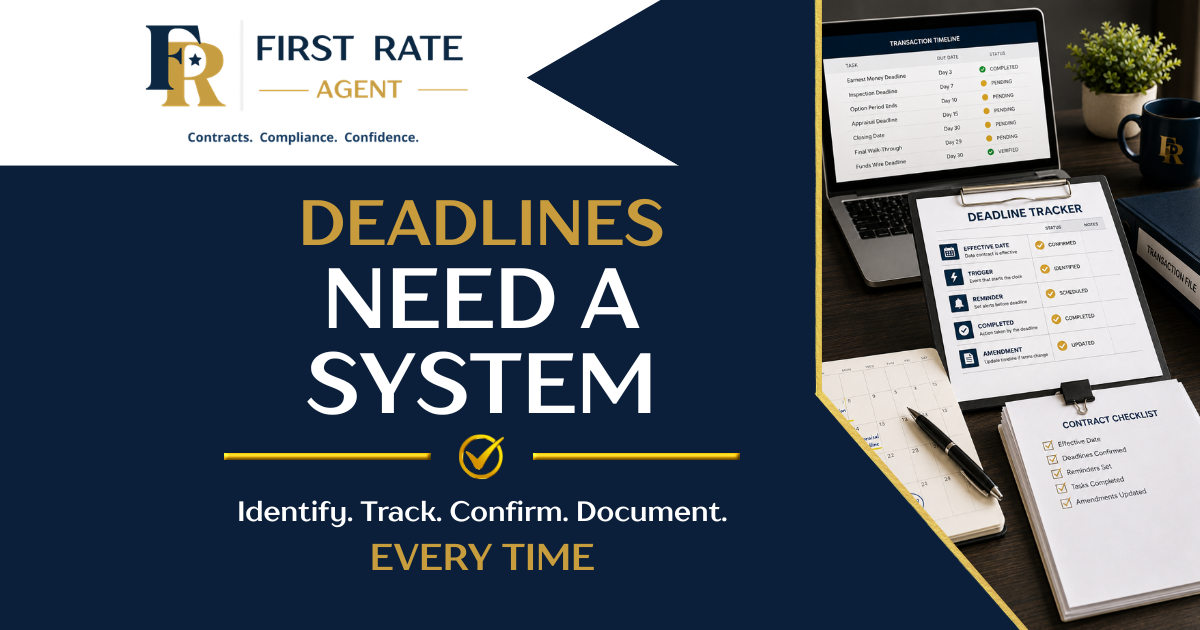
Use Statuses In Addition To Dates
A simple status system can make a deadline tracker much more useful.
For each important deadline, consider tracking:
Identified — The contract has been reviewed and the deadline calculated.
Pending — The deadline is active, and the underlying task remains open.
In Progress — The client or another transaction participant must act.
Completed — The required action occurred.
Verified — Evidence of completion has been reviewed and preserved.
That approach helps prevent a common transaction-management problem: assuming that because someone was asked to do something, the task actually happened.
“Sent reminder to buyer” and “buyer delivered option fee” are not the same status and they have vastly different consequences when something happens.
Know Which Deadlines Require Extra Attention
Some deadlines are more important than others in a transaction. And those require extra vigilance from the agent.
Paragraph 5 of the current resale contract expressly states that time is of the essence for the earnest-money and termination-option provisions and requires strict compliance with the time for performance. Failure to timely deliver the option fee can eliminate the buyer’s unrestricted termination right, while failure to timely deliver earnest money gives the seller contractual remedies.
Other deadlines can affect termination rights, objections, financing protections, disclosure rights, or closing obligations.
Your system should make high-consequence dates stand out and be visually obvious so they catch your attention and signify at a glance that they are more important.
A Practical Deadline Workflow
For each new contract, consider using this process:
1. Review the fully executed contract and every addendum
Do not rely on a template, prior offer, an earlier draft, or assumptions about what the document should say.
2. Identify each contractual time period
Look for both fixed dates and deadlines triggered by later events.
3. Record the triggering event or date
Document the Effective Date, receipt date, delivery date, amendment date, or other event that starts the applicable period.
4. Calculate the deadline
Apply the actual language of the controlling document. Remember that different provisions may contain different timing rules or extension provisions.
5. Create an advance reminder
Give yourself enough time to communicate with the client and complete the necessary work.
6. Assign responsibility
Identify who must act: buyer, seller, lender, title company, agent, attorney, inspector, or another participant.
7. Monitor the task
Do not assume that an email, reminder, or request equals completion.
8. Confirm completion
Verify that the required action actually occurred.
9. Preserve the evidence
Save the relevant document, communication, receipt, transmission record, or other evidence in the transaction file.
10. Recheck everything after an amendment or new triggering event
Update both deadlines and advance reminders immediately.
The Handoff Test
Here is a useful way to evaluate your deadline system:
Could another competent agent or transaction coordinator take over this file tomorrow and know exactly what is due next?
- Without calling you?
- Without searching through your email?
- Without asking you which dates you were worried about?
A strong transaction system should make the answer yes.
The person reviewing the file should be able to identify:
- The important upcoming deadlines;
- What event created each deadline;
- Who is responsible for the next action;
- What has already been completed;
- What remains outstanding; and
- Where the supporting documentation is stored.
If that information exists only in your head, you do not yet have a deadline system.
The Bottom Line
Real estate deadlines are not difficult because agents cannot read a calendar.
They are difficult because transactions contain multiple dates, different triggering events, changing contract terms, client decisions, third-party responsibilities, and consequences that may depend on precise performance.
The solution is not more reminders or a more cluttered calendar
The solution is a repeatable process:
Identify the deadline. Record what triggered it. Create an advance reminder. Assign the task. Confirm completion. Preserve the evidence.
Do that consistently, and deadline management becomes less dependent on memory and much more resistant to last-minute surprises.
First Rate Agent provides educational information for Texas real estate professionals. Contract requirements and deadlines depend on the specific transaction and controlling documents. Agents should follow their broker’s policies and seek appropriate legal guidance when interpretation of contractual rights or remedies is required.
Related Articles
If you found this article helpful, you may also want to read:
The New TREC Water Disclosure: What Texas Agents Need to Understand Before Checking Paragraph 7(I)
A practical guide to the new TREC Water Disclosure form, including how the new form differs from the Seller’s Disclosure Notice, when delivery is required, and how listing agents can build it into the listing workflow.
Why Clicking “Send” Is Not the End of the Job in a Texas Real Estate Transaction
A clean transaction file preserves both the final document and the transmission record showing what was sent, when, how, and to whom.
How Texas Agents Should Confirm Client Instructions in Writing
A practical guide to confirming important client instructions in clear, simple, written language so the client’s decision, the agent’s next step, and the applicable deadline remain easy to understand and review later.
About Michael Hughes
Michael Hughes is a Texas real estate attorney, broker, educator, and former Managing Broker for eXp Realty Texas, where he oversaw compliance operations for nearly 10,000 agents statewide.
With more than 20 years of legal experience and over a decade in Texas real estate brokerage, Michael helps agents navigate contracts, compliance, risk management, and transaction systems through First Rate Agent and Advantage TC.
A Better Transaction Starts With a Better System
Tracking deadlines is only one part of keeping a transaction organized from contract to close. Advantage TC helps Texas agents manage deadlines, documents, communications, and transaction-file details through a consistent contract-to-close process.